Ark augmented reality is a new idea in AR that combines artificial intelligence with real-world interaction. Many people search for it because the term is confusing and often mixed with other technologies.
This article explains what Ark augmented reality really is, how it works, its main features, and why it is important for the future of AR.
What Is Ark Augmented Reality?
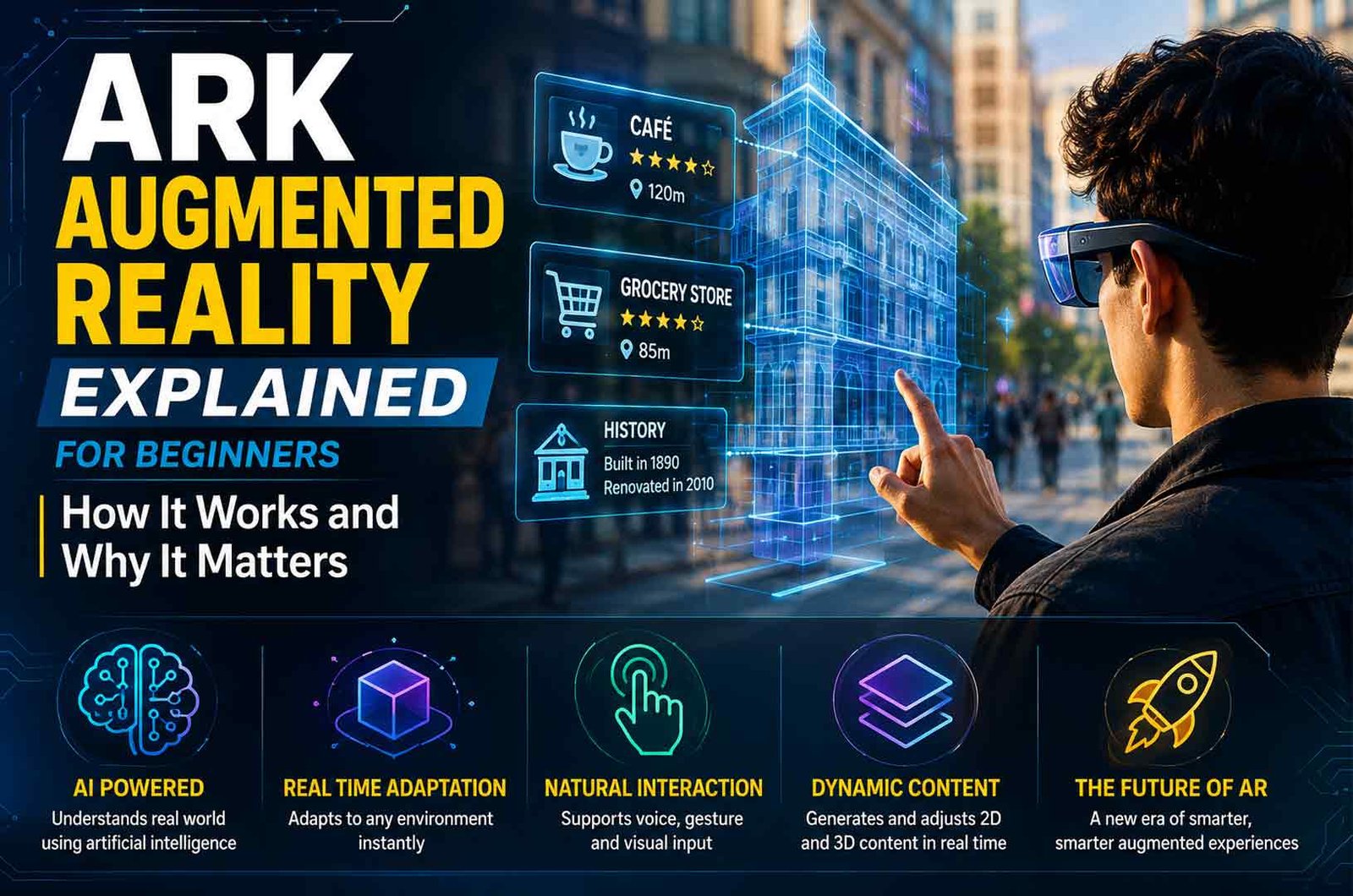
Ark augmented reality is an advanced form of augmented reality that uses artificial intelligence to understand real-world environments and create dynamic digital content.
In simple terms, it is a smarter version of AR. It does not just place objects on the screen. It tries to understand the space and respond in a natural way.
The full name is Augmented Reality with Knowledge Inference Interaction (ArK). It was introduced in a 2023 research paper by Microsoft Research and academic partners.
It is important to know that Ark augmented reality is not a product or app. There is no official software or tool you can download. It is still a research concept that shows how future AR systems could work.
The term is also confusing because it may refer to different things:
-
A research framework (the main meaning)
-
A kiosk-based AR system developed in Portugal
-
A mix-up with Apple’s ARKit
-
General blog usage without a clear definition
Because of this, many online articles give mixed or incorrect explanations.
How Ark Augmented Reality Works
Ark augmented reality works by combining AI knowledge with real-world input to generate digital scenes in real time.
Instead of relying on pre-built maps or markers, it can understand a new environment and adjust its output instantly.
Basic Process
The system follows a simple flow:
-
It scans and understands the environment
-
It uses AI knowledge to interpret the scene
-
It generates or adjusts digital content
-
It displays the result in real time
This allows it to work even in places it has never seen before.
Knowledge Memory
Knowledge memory is a key part of Ark augmented reality.
The system uses large AI models and external data to understand objects and spaces. It can remember context, preferences, and patterns.
For example, it may recognize a table and understand its purpose without being trained on that exact room.
Cross-Modality Input
Ark uses multiple types of input at the same time:
-
Camera (visual data)
-
Text or instructions
-
Audio input
-
Gestures or movement
By combining these inputs, the system builds a more complete understanding of the environment.
Scene Generation
After understanding the environment, the system creates or updates digital content.
This can include:
-
Placing objects in the correct position
-
Adjusting lighting and size
-
Generating new 2D or 3D scenes
This happens in real time and adapts as the environment changes.
Key Features of Ark Augmented Reality
Real-Time Environment Understanding
Works in New Spaces
Dynamic Scene Generation
-
Creates and edits 2D and 3D content
-
Adapts content based on space, lighting, and objects
Knowledge-Based Interaction
Multi-Input Support
-
Works with voice, gesture, text, and visual input
-
Combines inputs for better accuracy
Interactive Control
Ark Augmented Reality vs Traditional AR
Traditional augmented reality systems work in a limited way. They usually place digital objects on top of the real world without deep understanding.
Ark augmented reality improves this by adding intelligence and adaptability.
How Traditional AR Works
-
Uses markers or pre-mapped spaces
-
Places static objects in fixed positions
-
Limited ability to adapt to changes
How Ark Augmented Reality Is Different
-
Understands environments instead of just displaying content
-
Works in new spaces without setup
-
Generates content dynamically
-
Adjusts based on real-time conditions
Comparison with Other Technologies
-
Virtual Reality (VR): Fully digital environment, no real-world interaction
-
Mixed Reality (MR): Combines real and virtual elements, but still depends on hardware and setup
-
Ark Augmented Reality: Focuses on intelligent interaction and real-time adaptation using AI
Technology Behind Ark Augmented Reality
Ark augmented reality depends on several advanced technologies working together.
Artificial Intelligence Models
AI models provide the knowledge needed to understand the environment.
These models:
The system uses this knowledge instead of relying only on pre-programmed rules.
Scene Generation Systems
Scene generation tools create digital environments based on real-world input.
They:
Cross-Modal Reasoning
The system combines different types of data to make decisions.
For example:
-
Visual data + text input
-
Audio + gesture input
This improves accuracy and flexibility.
Hardware Example: ARK Kiosk System
One version of Ark augmented reality uses a simple hardware setup instead of expensive headsets.
This setup includes:
This design shows that AR can work without high-end wearable devices.
Processing Requirements
Ark augmented reality needs strong computing power.
This is because it must:
Real-World Uses of Ark Augmented Reality
Ark augmented reality is still in development, but many practical uses are already clear.
Education
Retail
-
Helps users visualize products in real spaces
-
Suggests placement, color, and design
Architecture and Planning
Training and Simulation
-
Provides real-time instructions in new environments
-
Useful for medical, industrial, and emergency training
Gaming
Remote Work and Collaboration
Entertainment
Benefits of Ark Augmented Reality
Ark augmented reality offers several practical benefits compared to traditional AR systems.
-
It works in new environments without setup. This reduces time and effort.
-
It creates more realistic and useful digital content. The system adjusts to real-world conditions.
-
It supports personalized experiences. Content can change based on user behavior and context.
-
It reduces the need for manual scene mapping. This is a major cost in many AR projects.
-
It can scale across industries such as education, retail, and training.
Another important benefit is flexibility. Ark augmented reality can work with different types of input and adapt to changing conditions in real time.
Limitations and Challenges
Ark augmented reality also has clear limitations.
- It requires strong hardware and processing power.
- It depends on the quality of AI models. If the model makes a mistake, the output may be incorrect.
- Real-time performance can be difficult. Latency and tracking issues may affect accuracy.
- The system design is complex. It needs multiple technologies working together.
There are also practical limits.
- It is still in the research stage.
- It is not widely tested in real-world conditions.
- There is no public version available for general use.
These limits show that the technology is still developing.
Privacy, Security, and Ethical Concerns
Ark augmented reality raises important concerns about data and safety.
The system may collect and store:
- User preferences
- Movement and behavior
- Details about physical spaces
This creates questions about data ownership. It is not always clear who controls or stores this information.
There is also a risk of misuse. Continuous scanning of environments may lead to privacy issues if not properly managed.
Bias is another concern. If AI models are trained on limited or biased data, the system may produce incorrect or unfair results.
Clear rules and standards are needed to handle these risks.
Is Ark Augmented Reality Available Today?
Ark augmented reality is not available as a product.
There is:
- No official app
- No software download
- No commercial device built on this system
It exists as a research framework introduced in 2023. Some modern AR tools may use similar ideas, but they are not the same system.
If an app uses the name “Ark augmented reality,” it is usually unrelated to the research.
Market Trends and Future Potential
The growth of AR and AI is increasing interest in Ark augmented reality.
The AR and VR market is expanding quickly. Businesses are investing in tools that combine real-world interaction with AI.
Ark augmented reality fits into this trend because it focuses on intelligent and adaptive systems.
In the future, this approach may support:
- Smart glasses and wearable devices
- AR-based remote workspaces
- Training tools that adapt to users
- Healthcare and educational applications
Although the system is still in development, its ideas are already influencing newer AR tools.
Common Problems and Practical Tips
Poor Scene Understanding
Sometimes the system may not correctly understand objects or space.
Tip: Use better input data and improve model training. Clear visuals and accurate sensors help.
Incorrect Object Placement
Virtual objects may appear in the wrong position.
Tip: Improve tracking systems and combine multiple inputs such as vision and depth data.
Performance Issues
Real-time processing can slow down the system.
Tip: Use stronger hardware and optimize software performance.
Limited Real-World Testing
The system has not been widely tested in all environments.
Tip: Test in different conditions and improve models with more diverse data.
Bottom Line
Ark augmented reality is not a simple tool or app. It is a research-based approach to making AR systems smarter.
It focuses on using AI to understand environments and generate content in real time. This makes AR more flexible and useful.
The technology is still in development. It is not available for public use yet.
However, it shows how future AR systems may work. Many of its ideas are already shaping new tools and platforms.
(FAQs)
How is Ark different from normal AR?
Ark augmented reality adapts to new environments and generates content, while normal AR uses fixed overlays.
Can I download Ark augmented reality?
There is no official app or software available.
Who developed Ark augmented reality?
It was developed by Microsoft Research with academic partners.
What are the main uses of Ark augmented reality?
Education, training, gaming, retail, and remote collaboration.
Who developed Ark augmented reality?
It was developed by Microsoft Research with academic partners.
What is the future of Ark augmented reality?
It may become part of future AR tools, especially with AI and wearable devices.
Keep Reading:
Content://cz.mobilesoft.appblock.fileprovider/cache/blank.html and Android FileProvider Explained








 Life Style1 year ago