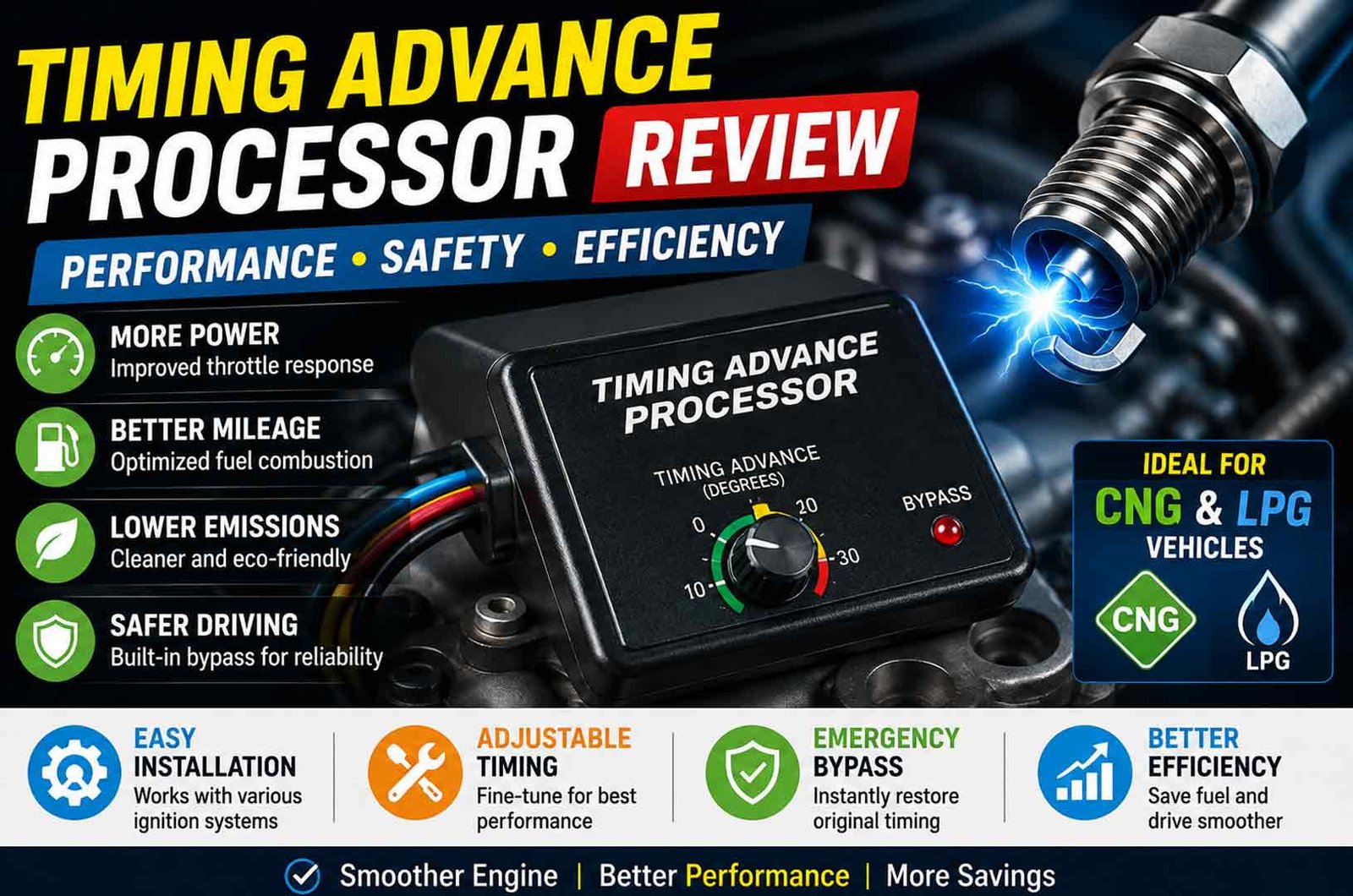
A timing advance processor is a small electronic device used in vehicles that run on CNG or LPG. It adjusts the engine’s ignition timing so the fuel burns at the right moment.
Many people search for a timing advance processor when they notice problems like low power, engine knocking, or poor fuel efficiency after switching from petrol to gas.
In this article, you will learn what a timing advance processor is, how it works, and how it affects performance, safety, and efficiency.
What Is a Timing Advance Processor
A timing advance processor is an electronic unit that changes the spark timing of an engine. It is mainly used in vehicles that run on CNG or LPG.
In petrol engines, ignition timing is set based on how petrol burns. But gas fuels burn more slowly. Because of this, the spark must happen earlier. A timing advance processor makes this adjustment.
The device is installed between the ignition system components. It takes the original signal and modifies it before sending it to the ignition coil or control unit.
Without this adjustment, the engine may not perform well when running on gas.
How a Timing Advance Processor Works
An engine needs the spark plug to fire at the correct time. This timing controls how the air and fuel mixture burns inside the engine.
A timing advance processor works by intercepting the ignition signal. It then shifts the timing slightly forward or backward.
For CNG and LPG, earlier ignition is usually needed. This is because these fuels take more time to burn compared to petrol.
The processor adjusts the signal so combustion happens at the best moment. This improves engine efficiency and reduces problems.
The amount of adjustment depends on:
-
Engine type
-
Fuel type
-
Driving conditions
Some processors allow manual adjustment, while others use preset settings.
Why Timing Advance Is Important for CNG and LPG
CNG and LPG behave differently from petrol. They have different combustion speeds and properties.
CNG has a higher octane rating and burns more slowly. LPG also burns differently and needs proper timing control.
If the timing is not adjusted:
-
The fuel may burn too late
-
Engine power can drop
-
Fuel efficiency becomes poor
-
Engine knocking may occur
A timing advance processor solves this by moving the spark earlier. This allows the fuel to burn fully and at the right time.
As a result, the engine runs smoother and more efficiently.
Types of Timing Advance Processors (By Ignition System)
Different vehicles use different ignition systems. A timing advance processor must match the system to work correctly.
Mechanical Breaker Point Systems
These systems are found in older vehicles. They use physical contact points and a distributor.
The timing advance processor connects between the distributor and the ignition coil. It adjusts the low-voltage signal from the breaker points.
Electronic Ignition with Distributor
These systems replace mechanical points with electronic switching. They still use a distributor.
The processor connects to the ignition module output. It can respond faster and handle electronic signals more accurately.
Electronic Ignition with Modules
More advanced systems use dedicated ignition modules. These modules already adjust timing based on engine speed and load.
A programmable timing advance processor is used here. It allows more precise control and tuning for different engines and fuels.
Crankshaft Position Sensor (CKP) Systems
Modern vehicles use sensors to track crankshaft position. These sensors send signals to the engine control unit.
There are two main types:
The timing advance processor must be able to process these signals correctly. It is installed inline with the sensor signal.
Key Features of Timing Advance Processors
Timing advance processors include several features that help improve engine performance and usability.
-
Adjustable timing range to match engine needs
-
Support for CNG and LPG fuel systems
-
Compatibility with different ignition systems
-
Programmable options in advanced models
-
Manual adjustment using switches or controls
-
Emergency bypass connector for safety
The emergency connector is important. It allows the system to be disabled quickly if there is a problem. This restores the original factory timing so the vehicle can continue running.
Performance Review: How Well Does It Work
A timing advance processor can improve engine performance when it is installed and adjusted correctly.
The most noticeable improvement is better engine power. The engine responds faster because the fuel burns at the right time.
Fuel efficiency also improves. Proper timing allows the engine to use fuel more effectively, which can reduce fuel consumption over time.
Engine operation becomes smoother. Problems like hesitation and rough running are reduced.
Emissions may also decrease. Better combustion leads to cleaner exhaust gases.
However, the results depend on correct setup. If the timing is not adjusted properly, performance may not improve and can even become worse.Safety and Reliability
A timing advance processor is generally safe when installed correctly. It is designed to work with the vehicle’s ignition system without changing the engine’s core design.
One important safety feature is the emergency bypass connector. If the processor fails or causes problems, this connector can disable the device. The ignition system then returns to its original factory timing.
This allows the vehicle to keep running even if the processor is not working.
Reliability depends on:
-
Proper installation
-
Correct wiring
-
Suitable model selection
Incorrect timing settings can affect engine performance. In some cases, too much advance can increase engine stress. This is why careful adjustment is important.
Most modern processors are stable and do not need frequent changes once set correctly.
Installation and Setup
Installing a timing advance processor requires basic knowledge of the ignition system. The device is connected inline with the ignition signal wires.
The general process includes:
-
Disconnecting the battery
-
Identifying ignition system connections
-
Connecting the processor according to wiring diagrams
-
Securing the device away from heat and moisture
After installation, the timing must be set. Most processors have simple controls like switches or adjustment knobs.
Once installed, the engine should be tested at idle and at different speeds. This helps confirm that the processor is working correctly.
For modern vehicles, installation can be more complex. In such cases, professional installation is recommended.
Adjustment and Calibration
After installation, the timing advance processor must be adjusted to match the engine and fuel type.
The timing is usually set within a specific range. A common starting point is around 10 to 15 degrees, but the exact value depends on the engine.
Adjustment is done using:
-
Built-in controls such as potentiometers or switches
-
Tools like a timing light
-
In advanced systems, an oscilloscope may be used
Fine-tuning is important. The engine should run smoothly without knocking or hesitation.
Recalibration may be needed over time. This can happen due to:
Regular checks help maintain performance.
Common Problems and Troubleshooting
Engine Knocking
Poor Acceleration
Engine Not Starting
Rough Idle
Processor Not Responding
If problems continue, the emergency bypass connector can be used to return the system to normal. This helps confirm whether the processor is the cause.
How to Choose the Right Timing Advance Processor
Choosing the correct timing advance processor is important for proper performance.
The first step is to identify the ignition system. Different systems need different processor types.
Next, check fuel compatibility. Most processors support both CNG and LPG, but some are designed for specific setups.
Other factors to consider include:
-
Required timing adjustment range
-
Need for programmable features
-
Build quality and brand reliability
-
Availability of safety features like bypass connectors
Brands like AEB are commonly used because they offer models for different ignition systems.
If unsure, it is best to consult a technician or installer before buying.
Benefits of Using a Timing Advance Processor
A timing advance processor can improve how an engine performs when using alternative fuels.
Main benefits include:
These improvements depend on correct setup and tuning.
Drawbacks and Limitations
There are some limitations to consider before installing a timing advance processor.
-
It must be installed correctly to work properly
-
Not all vehicles are compatible
-
Incorrect settings can reduce performance
-
Some models require periodic adjustment
-
There is an added cost for the device and installation
Understanding these limits helps avoid problems.
Maintenance and Best Practices
A timing advance processor does not require heavy maintenance, but regular checks are useful.
Good practices include:
-
Checking timing settings occasionally
-
Inspecting wiring connections
-
Keeping the device clean and protected
-
Using recommended settings for your engine
If performance changes, recalibration may be needed.
Professional inspection is helpful if issues appear.
Availability and Usage
Timing advance processors are commonly used in vehicles converted to CNG or LPG.
They are widely available through:
They are hardware devices. There are no subscriptions or software plans.
Usage is more common in regions where gas fuel is widely used.
Bottom Line
A timing advance processor is a useful device for vehicles running on CNG or LPG. It adjusts ignition timing so the engine works more efficiently with these fuels.
When installed and set correctly, it can improve performance, fuel economy, and engine smoothness.
However, proper selection, installation, and adjustment are important. Without these, the benefits may not be achieved.
For best results, it is often helpful to work with an experienced technician.
(FAQs)
Does a timing advance processor improve fuel economy?
Proper timing allows better combustion, which can improve fuel efficiency.
Is it safe to use a timing advance processor?
If installed correctly. Most devices include a bypass feature for safety.
Can it work on all vehicles?
Compatibility depends on the ignition system and engine type.
Is professional installation necessary?
It is recommended, especially for modern vehicles with complex systems.
Can it increase engine power?
Correct timing improves combustion, which can increase power output.
Keep Reading:
G+ Games Explained: Features, Benefits, and Safety Guide








 Life Style1 year ago