Critical thinking exercises are simple methods that help people think clearly, solve problems, and make better decisions. Many people search for these exercises because they want to avoid mistakes, reduce confusion, and improve their thinking at work or in daily life.
In this article, you will learn what critical thinking exercises are, why they matter, and how they work. You will also see simple methods you can use right away.
What Are Critical Thinking Exercises
Critical thinking exercises are step-by-step activities that train your brain to think in a clear and logical way. They help you understand information, question assumptions, and make decisions based on facts instead of guesses.
Normal thinking is often quick and based on habits. Critical thinking is slower and more careful. It focuses on checking facts, asking questions, and looking at different sides of a situation.
These exercises are used in many areas:
-
Workplaces for decision-making
-
Schools for learning and analysis
-
Daily life for solving personal problems
They are simple to start and do not need any special tools.
Core Skills Behind Critical Thinking
Critical thinking exercises are built on a few basic skills. These skills work together to improve how you think.
Analysis This means breaking information into smaller parts. It helps you understand complex ideas more easily.
Evaluation This is checking if information is true, useful, and reliable. It helps you avoid false or weak arguments.
Inference This means drawing conclusions based on facts and evidence. It prevents guessing without proof.
Interpretation This is understanding the meaning of information. It helps you decide what the information really shows.
Problem solving This is finding clear and logical solutions to a problem. It focuses on step-by-step thinking instead of quick reactions.
These skills improve with practice. Critical thinking exercises are designed to train all of them together.
Why Critical Thinking Exercises Matter
Critical thinking exercises are important because they improve how people handle information and decisions.
Many jobs now require strong thinking skills. Research shows that most employers want people who can analyze problems and make clear decisions. However, many people do not practice these skills regularly.
These exercises help by:
-
Reducing mistakes caused by quick assumptions
-
Improving understanding of complex problems
-
Helping people explain ideas clearly
-
Making it easier to handle new and difficult situations
They are useful in both professional and personal life. For example, they help in planning, managing risks, and solving daily challenges.
Key Benefits of Critical Thinking Exercises
Critical thinking exercises offer several clear benefits when practiced regularly.
-
Better decision-making You make choices based on facts and logic instead of emotions or guesses.
-
Improved problem-solving You can identify the real problem and find effective solutions.
-
Clear communication You can explain your ideas in a simple and logical way.
-
Reduced bias You become more aware of personal assumptions and avoid unfair judgments.
-
Flexible thinking You can look at situations from different angles and adapt easily.
-
Better planning and risk awareness You can identify possible problems before they happen.
These benefits build over time with regular practice.
How Critical Thinking Exercises Work
Critical thinking exercises work by slowing down your thinking process and making it more structured.
Instead of reacting quickly, you follow clear steps:
-
Observe the situation carefully
-
Ask questions about what is happening
-
Check facts and evidence
-
Consider different viewpoints
-
Draw a reasoned conclusion
Many exercises focus on finding the root cause of a problem, not just the surface issue. Others help you explore different perspectives or test your assumptions.
With regular use, these methods become natural. You start to think more clearly without needing to follow each step consciously.
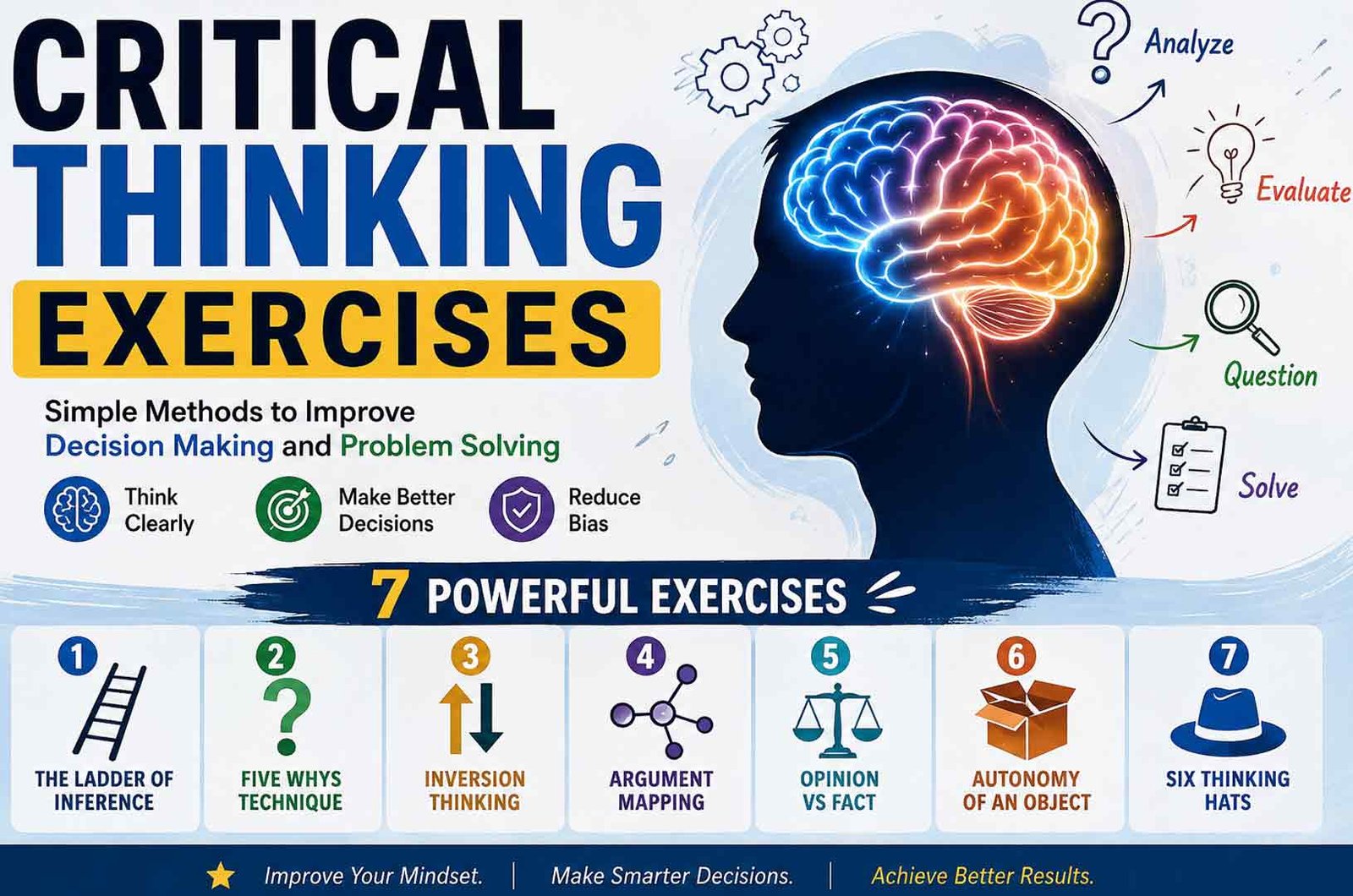
Critical Thinking Exercises You Can Use
Ladder of Inference
The Ladder of Inference is a model developed by Chris Argyris. It explains how people move from observing a situation to taking action.
The steps include:
People often move up this ladder quickly and skip important steps. This leads to wrong conclusions.
For example, if a coworker checks their phone during a meeting, you may assume they are not interested. In reality, they could be handling an urgent issue.
This exercise teaches you to slow down and question your assumptions before acting.
Five Whys Technique
The Five Whys technique was developed by Sakichi Toyoda. It is used to find the root cause of a problem.
The method is simple:
For example, if customers are unhappy:
This shows the real issue is staffing, not performance.
This exercise is easy to learn and useful for beginners.
Inversion Thinking
Inversion thinking means looking at a problem from the opposite direction.
Instead of asking how to succeed, you ask how to fail. Then you avoid those mistakes.
For example, if you want to launch a product:
By identifying risks early, you can prevent them.
This method is helpful for planning and risk management.
Argument Mapping
Argument mapping is a way to organize ideas and arguments clearly.
It breaks an argument into parts:
-
Main conclusion
-
Supporting reasons
-
Opposing views
-
Responses to those views
This helps you see the full picture of a decision.
For example, when deciding on remote work:
-
Benefits include flexibility and lower costs
-
Concerns include communication and security
-
Solutions can address these concerns
This method improves clarity and structured thinking.
Distinguishing Opinion from Fact
This critical thinking exercise helps you separate what is true from what is personal belief. It is important when reading news, reports, or online content.
A fact is something that can be checked and proven. An opinion is based on feelings, beliefs, or interpretation.
For example:
To practice this exercise, you can:
-
Read an article and mark facts and opinions
-
Look for words like “I think,” “seems,” or “probably”
-
Check if the statement can be proven with data
This method helps you avoid confusion and make better decisions based on real information.
Autonomy of an Object
This exercise was developed by Dr. Marlene Caroselli. It helps you solve problems by thinking in a creative way.
The idea is to treat a problem like a person or object and place it in a different situation. This helps you see new solutions.
Basic steps:
-
Define the problem clearly
-
Imagine the problem as something else
-
Place it in a different time or setting
-
Use that setting to find ideas
For example, if time management is a problem, you might imagine time as a “thief.” Then you think about how to stop a thief. This can lead to ideas like setting limits, creating schedules, or adding reminders.
This method is useful when normal thinking does not give good solutions.
Six Thinking Hats
The Six Thinking Hats method was created by Edward de Bono. It helps people look at a problem from different angles.
Each “hat” represents a way of thinking:
-
White Hat: Focus on facts and data
-
Red Hat: Focus on feelings and intuition
-
Black Hat: Look at risks and problems
-
Yellow Hat: Look at benefits and value
-
Green Hat: Think of new ideas and solutions
-
Blue Hat: Manage the thinking process
This method is often used in teams. Each person focuses on one type of thinking at a time. This avoids confusion and improves discussion.
It is useful for planning, decision-making, and solving complex problems.
How to Use Critical Thinking Exercises in Daily Life
Critical thinking exercises are not only for work. You can use them in daily situations.
You can:
-
Question your first reaction before making a decision
-
Check facts when reading news or online content
-
Think about other possible explanations
-
Write down important decisions and review them later
For example, if you need to make a purchase, you can ask why you need it, compare options, and check facts before deciding.
Regular use helps you think more clearly without extra effort.
Critical Thinking Exercises in the Workplace
In the workplace, these exercises improve decisions and teamwork.
They are used in:
-
Meetings to explore ideas fully
-
Project planning to find risks early
-
Problem-solving to identify root causes
-
Performance reviews to avoid wrong assumptions
-
Strategy planning to improve results
For example, teams may use the Six Thinking Hats method to discuss a new idea. This ensures that all viewpoints are considered.
These methods help teams make balanced and informed decisions.
Best Exercises for Beginners
Some critical thinking exercises are easier to start with.
The best options for beginners are:
You can start with small problems. Practice for 10 to 15 minutes each day. Over time, it becomes easier to apply these methods in real situations.
Common Mistakes to Avoid
Many people struggle with critical thinking because of simple mistakes.
Common issues include:
-
Making quick decisions without checking facts
-
Ignoring important evidence
-
Letting personal bias affect judgment
-
Confusing opinion with fact
-
Not practicing regularly
Avoiding these mistakes helps you improve faster.
Tips to Improve Critical Thinking Faster
You can improve your skills with simple habits.
-
Practice every day, even for a short time
-
Use real-life problems instead of theory
-
Ask clear and specific questions
-
Stay open to other viewpoints
-
Review your past decisions
These steps help you build strong thinking skills over time.
Limitations of Critical Thinking Exercises
Critical thinking exercises are useful, but they have some limits.
-
They take time to learn
-
Some methods may feel complex at first
-
Results are not immediate
-
Regular practice is required
These limits are normal. With time, the process becomes easier.
Who Should Use Critical Thinking Exercises
Critical thinking exercises are useful for many people.
They are helpful for:
-
Students who want to improve learning
-
Professionals who make decisions
-
Managers who lead teams
-
Anyone who wants clearer thinking
No special background is needed. Anyone can start.
Tools and Methods Comparison
Different exercises serve different purposes. Choosing the right one depends on your goal.
-
The Five Whys is best for finding root causes
-
The Ladder of Inference helps check assumptions
-
Inversion thinking is useful for risk planning
-
Argument mapping helps with complex decisions
-
Six Thinking Hats works well in teams
-
Autonomy of an Object supports creative thinking
Time and difficulty vary. Simple methods take about 10–20 minutes. More advanced ones may take longer.
Bottom Line
Critical thinking exercises are simple tools that improve how you think and make decisions. They help you understand problems, check facts, and avoid mistakes.
You do not need special tools or training to start. Begin with simple methods and practice regularly. Over time, these skills become part of your normal thinking.
(FAQs)
How often should I practice critical thinking exercises?
Practice daily if possible. Even 10 to 15 minutes can help improve your skills.
Can critical thinking exercises improve decision-making?
They help you think clearly and choose better options based on facts.
Are critical thinking exercises useful at work?
They improve teamwork, planning, and problem-solving.
How do I know if my thinking is improving?
You will notice better decisions, clearer ideas, and fewer mistakes over time.
Do these exercises take a lot of time?
Many exercises can be done in 10 to 30 minutes.
Can teams use critical thinking exercises together?
Methods like Six Thinking Hats are designed for group use.
Keep Reading:
Instagram Highlight Viewer Review: Top Tools, Features, and Pricing







 Life Style1 year ago