Telemetryczny is a Polish term connected with telemetry, which means measuring information from a distance and sending that data somewhere else for monitoring or analysis.
People may see the word used with vehicles, industrial machines, medical devices, GPS systems, and remote monitoring equipment. It is important to know that Telemetryczny is not one company, app, or single technology product.
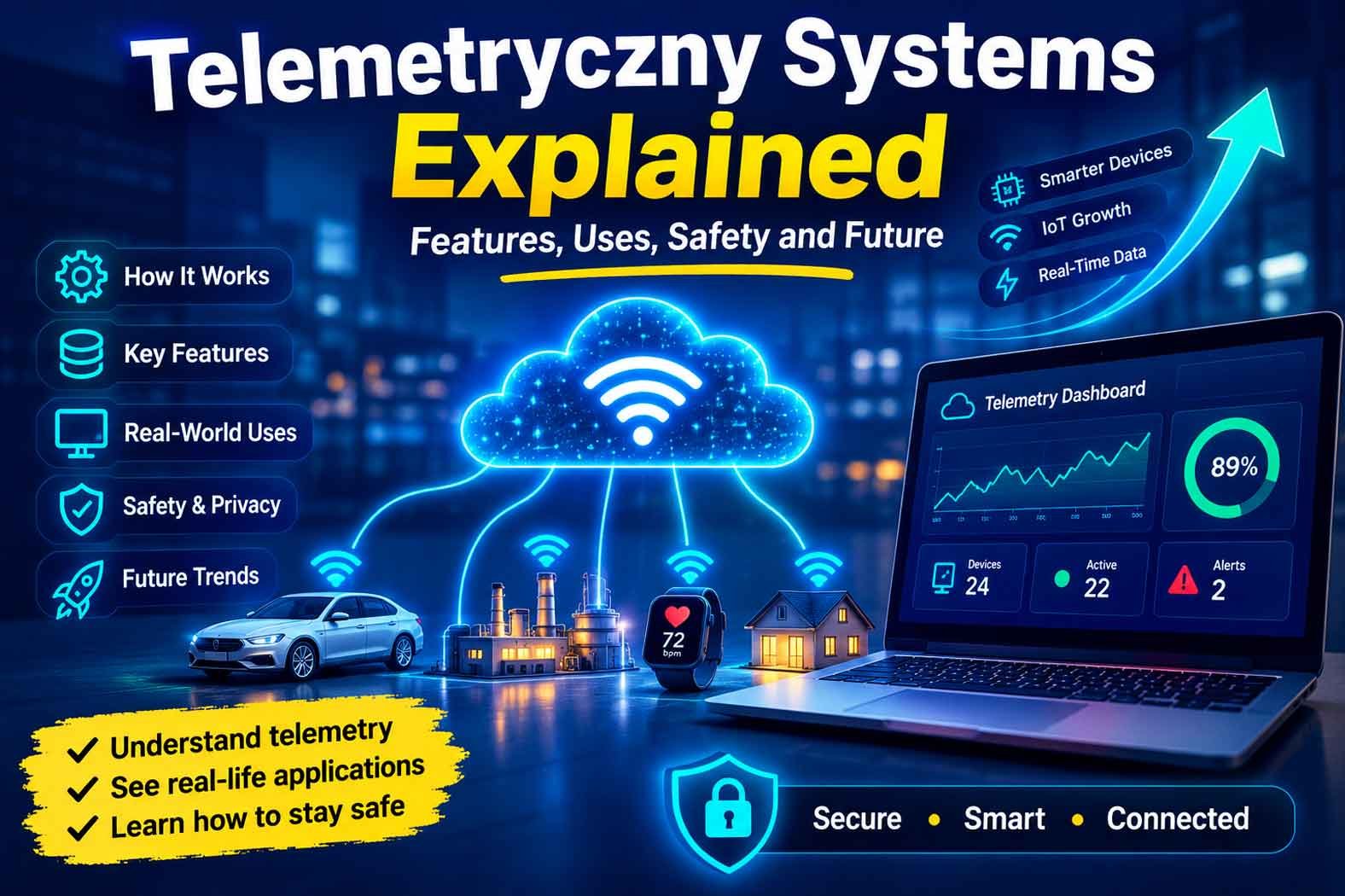
This article explains what telemetryczny means, how telemetry systems work, their main components, common types, automotive uses, and other important applications.
What Does Telemetryczny Mean?
Telemetryczny is a Polish adjective that means something related to telemetry. For example, system telemetryczny means a telemetry system, while moduł telemetryczny means a telemetry module.
Telemetry itself is the process of measuring data at one location and sending it to another location.
A simple example is a remote weather station. Sensors can measure temperature, rainfall, humidity, and wind speed. The measurements are then sent to a computer without a person having to visit the station.
The same idea is used in cars, factories, hospitals, aircraft, farms, power systems, and many other areas.
Some online sources present “Telemetryczny” as if it were the official name of a modern automotive platform. This is misleading. There is no confirmed single product called the Telemetryczny System that controls all these uses.
Instead, the word describes a broad group of remote monitoring technologies.
How Does a Telemetryczny System Work?
Most telemetry systems follow a simple process.
First, sensors measure something. This may include speed, temperature, pressure, voltage, vibration, location, heart rate, or another value.
The information is then collected by a telemetry device or control unit. This device prepares the data for transmission.
Next, the data is sent to another location. Depending on the system, it may travel through a cellular network, Wi-Fi, Bluetooth, radio, satellite, Ethernet, or another communication method.
After the information reaches the receiving system, software stores and processes it. The software may create charts, reports, warnings, or automatic alerts.
For example, a fleet system may detect that an engine temperature is becoming unusually high. It can warn the fleet manager before the problem becomes more serious.
Some systems only send information. More advanced systems may also allow users to send commands back to the equipment.
Main Components of Telemetryczny Systems
A telemetry system can be simple or very advanced, but most systems use several basic parts.
Sensors collect the original measurements. They may measure heat, pressure, movement, speed, fuel use, electrical conditions, or location.
A telemetry module or transmitter receives this information and prepares it for communication.
A communication network moves the data. This could be a mobile network, radio connection, private network, satellite link, or wired connection.
The information may then be stored on a local server, cloud platform, or edge device.
Software analyzes the data and presents it through a dashboard, computer program, or mobile app. Users may see live information, historical records, alerts, and device status.
The exact components depend on the purpose. A small fitness sensor needs very different hardware from a large industrial monitoring network.
How Telemetry Data Is Transmitted
Telemetry can use many communication methods.
Older and industrial systems often use GSM or GPRS. Modern systems may use 4G or 5G when faster mobile communication is needed.
Wi-Fi is useful where equipment is close to an existing network. Bluetooth is often used for short-distance communication, especially with wearable or personal devices.
Radio communication can be useful when normal internet access is not available. Satellite telemetry is important for very remote places, including aircraft, ships, scientific equipment, and space missions.
Some systems use wired technologies such as Ethernet or fiber optics when a physical connection is practical.
Technologies such as LoRaWAN are also useful for devices that send small amounts of information over long distances while using little power.
This means telemetry does not always need the public internet. The best connection depends on range, speed, power use, cost, and network coverage.
Types of Telemetryczny Systems
Telemetry systems can be grouped in several ways.
A single-channel system measures one main value. A multi-channel system can collect several measurements at the same time.
Systems may also be divided into wired and wireless types.
Wireless systems can use cellular networks, radio, Bluetooth, Wi-Fi, or satellites. Wired systems use physical cables.
Another useful way to classify telemetry is by purpose. Common examples include:
- Vehicle and fleet telemetry
- GPS tracking systems
- Industrial telemetry
- Medical telemetry
- Environmental monitoring
- Satellite telemetry
- Energy and utility monitoring
These are practical categories rather than one official worldwide classification.
Telemetryczny in Cars and Fleet Management
Vehicle telemetry is one of the most common uses of this technology.
A vehicle can collect information from GPS devices, onboard electronics, and other sensors. The information may include location, speed, engine condition, fuel use, battery status, mileage, and driving behavior.
Fleet managers can use this data to see where vehicles are located and how they are being used.
Telemetry may also record rapid acceleration, hard braking, speeding, or unusual vehicle activity. This can help companies review driver behavior and improve safety policies.
Another important use is maintenance. Vehicle data can show signs of possible mechanical problems before a breakdown happens. This helps companies plan servicing and reduce unexpected downtime.
Geofencing is another common feature. A virtual boundary is created around a location. The system can send an alert when a vehicle enters or leaves that area.
Telemetry in Motorsport and Connected Vehicles
Motorsport teams use telemetry to study how a racing vehicle performs.
Sensors can monitor engine temperature, speed, acceleration, braking, fuel use, and other technical values. Engineers study this information to understand how the vehicle behaves during testing or racing.
Telemetry also helps teams identify mechanical problems and compare performance between different laps or vehicle settings.
Connected road vehicles use similar ideas. Modern cars can collect diagnostic and location information and send selected data to other systems.
Vehicle-to-Everything, or V2X, is another developing area. It allows vehicles to exchange information with other vehicles, road infrastructure, and connected systems.
Fast local processing, known as edge computing, can also be useful when a vehicle needs to react to data without waiting for a distant cloud server.
Other Major Uses of Telemetryczny Technology
Telemetry is not limited to vehicles.
Healthcare
Medical telemetry can monitor heart rhythm, heart rate, blood oxygen, blood pressure, glucose levels, and other health measurements.
A Holter monitor is one example of medical monitoring technology. Medical telemetry should not be confused with normal automotive telemetry.
Manufacturing
Factories use telemetry to monitor machines, motors, temperature, pressure, vibration, energy use, and production conditions.
This information can help maintenance teams notice unusual changes before equipment fails.
Aviation and Space
Aircraft use large amounts of sensor data to monitor engines, fuel systems, navigation, and other important equipment.
Telemetry is also essential in space missions because satellites and spacecraft operate far from the people controlling them. Their technical and scientific data must be transmitted back to Earth.
Agriculture and Utilities
Farmers can monitor soil moisture, weather, irrigation systems, and livestock.
Energy and water companies may use telemetry to monitor transformers, pumps, pipelines, tank levels, voltage, water pressure, and other infrastructure.
Environmental systems can also monitor air quality, river levels, weather, and water conditions.
Main Features of Modern Telemetryczny Systems
Modern telemetry systems may offer several useful features depending on the equipment and software being used.
Real-Time Monitoring
Many systems can show current measurements with very little delay. This is useful when users need to react quickly to changes.
Remote Access
Users can often check information from another location through a computer, dashboard, or mobile device.
Alerts and Notifications
A system can send a warning when a measurement goes outside a set limit. For example, it may report excessive temperature, low battery power, or unusual vehicle activity.
Historical Data
Telemetry software can store previous measurements. This helps users compare performance over time and find patterns.
GPS Tracking
Vehicle and transport systems may include GPS data for live location, trip history, route monitoring, and geofencing.
Reporting and Analytics
Software can organize large amounts of raw information into charts, summaries, and reports that are easier to understand.
Some modern systems also support automatic analysis, predictive maintenance, cloud integration, and connections with IoT platforms. These features depend on the specific telemetry solution and are not available in every system.
Benefits of Telemetryczny Systems
Telemetryczny systems can make monitoring faster and more accurate. They allow people to check equipment, vehicles, or other systems without being physically present.
One major benefit is early problem detection. A sensor may show rising temperature, unusual vibration, low pressure, or another warning sign before equipment fails.
Telemetry can also reduce manual inspections. This can save time in factories, fleets, utilities, and remote locations.
Other benefits may include better maintenance planning, improved resource use, fewer unexpected failures, faster alerts, and easier access to historical data.
In fleet management, telemetry may help improve route planning, fuel monitoring, vehicle use, and maintenance schedules.
These benefits depend on the quality of the sensors, software, network, and how well the organization uses the collected data.
Safety, Privacy, and Cybersecurity
Telemetry systems can collect sensitive information. This may include vehicle location, driver behavior, health data, equipment status, or business information.
For this reason, security is important.
Data should be protected while it is being sent and stored. Encryption helps prevent other people from reading intercepted information.
Strong passwords, authentication, and access controls should also be used. Employees should only have access to the information they need.
Software and device firmware should be kept updated because old versions may contain security weaknesses.
Privacy also matters. Location data and health information may be linked to real people. Organizations must follow applicable privacy and data protection laws.
In the European Union, personal data may fall under GDPR rules.
Telemetry itself is not automatically safe or unsafe. Security depends on how the system is designed, configured, updated, and managed.
Common Problems and Limitations
Telemetry systems are useful, but they also have limits.
Poor Network Coverage
Weak cellular, radio, or internet coverage can delay information or stop transmission.
A practical solution is to store data locally until the connection returns. Important systems may also use backup communication methods.
Sensor Errors
A damaged or poorly calibrated sensor may send incorrect information.
Sensors should be checked, maintained, and calibrated when required.
Too Much Data
Collecting every possible measurement can create large amounts of unnecessary information.
Organizations should decide which measurements are actually useful before setting up the system.
Compatibility Problems
Older machines or vehicles may not connect easily with modern telemetry software.
Adapters, gateways, or special integration software may be needed.
Power Use
Remote sensors may depend on batteries. Frequent data transmission can reduce battery life.
Low-power networks and less frequent transmission can help when instant updates are not necessary.
Cost and Training
Hardware, software, installation, connectivity, and staff training can increase the total cost.
Planning the system around clear needs helps avoid unnecessary spending.
Telemetryczny Costs and Pricing
There is no standard price for Telemetryczny because it is not one commercial product.
The cost depends on the type and size of the telemetry system.
A basic setup may only need one sensor and a small communication device. A large fleet or industrial installation may require hundreds of sensors, cloud software, data plans, dashboards, and custom integration.
Common costs can include sensors, GPS devices, telemetry modules, gateways, installation, mobile or satellite data, cloud storage, software subscriptions, maintenance, and training.
Some systems may use a monthly software or connectivity fee. Others may mainly involve hardware and maintenance costs.
For this reason, pricing should always be checked for the specific product or provider.
Real Examples of Telemetry-Related Devices and Systems
Several real products show how wide the telemetry field is.
The INVENTIA MT-020 is an older GSM/GPRS telemetry module used for remote monitoring, alarms, diagnosis, and control.
The COMMON CMB-03 is a battery-powered GSM telemetry module mainly designed for industrial applications.
The TECHBASE iMod X1000 belongs to a family of industrial monitoring and data-logging equipment.
The Polar H7 is a heart-rate sensor. It shows that telemetry can also be used in health and fitness.
A Holter monitor records heart activity over time. It belongs to medical monitoring and should not be treated as an automotive telemetry device.
eCall is another useful example. In Europe, it can automatically contact emergency services after a serious road accident and send important location information.
Poland’s e-TOLL system also uses vehicle location data for electronic road charging.
These systems are not parts of one shared Telemetryczny platform. They are separate examples of telemetry-related technology.
Telemetryczny, IoT, Cloud, and Edge Computing
Telemetry and the Internet of Things are closely connected, but they are not the same thing.
IoT refers to connected devices that can communicate with other systems. Telemetry is the process of measuring and sending information from those devices.
For example, a connected temperature sensor may be an IoT device. Sending its temperature readings to a server is telemetry.
Cloud computing gives telemetry systems a place to store and analyze large amounts of data. It also allows users to access dashboards from different locations.
Edge computing works differently. It processes some information close to the device instead of sending everything to a distant server.
This can reduce delay and network use. It is useful in vehicles, factories, and other situations where a fast response is important.
How AI and Machine Learning Improve Telemetry
AI and machine learning can help analyze large telemetry datasets.
A normal system may send an alert when temperature goes above a fixed limit.
An AI-based system may study normal patterns and notice unusual behavior before the value reaches that limit.
AI can be used for anomaly detection, failure prediction, route optimization, energy analysis, and predictive maintenance.
Machine learning models may improve as they receive more useful historical data.
However, not every telemetry system needs AI. Many simple systems work well with normal rules and alerts.
AI results also depend on good-quality data. Incorrect sensor readings can lead to poor predictions.
Best Practices for Using Telemetryczny Systems
A good telemetry system should start with a clear purpose.
Organizations should decide what they actually need to monitor before buying hardware.
Useful practices include:
- Choose sensors that match the job.
- Keep sensors properly maintained.
- Collect only useful data.
- Use suitable communication technology.
- Encrypt sensitive information.
- Limit access to authorized users.
- Keep software and firmware updated.
- Check network quality.
- Use backup methods for important systems.
- Train employees to understand alerts and reports.
- Review collected data regularly.
- Plan for future growth when choosing software.
Collecting information has little value if nobody uses it to make better decisions.
Telemetryczny vs. Traditional Monitoring
Traditional monitoring often depends on a person checking equipment at certain times.
Telemetry can collect information automatically and continuously.
Traditional monitoring may work well for simple equipment that does not need frequent checks. It can also be cheaper when remote access is unnecessary.
Telemetry is more useful when equipment is spread across many locations, when conditions change quickly, or when early warnings are important.
It can provide remote access, historical records, automatic alerts, and faster problem detection.
However, telemetry does not completely remove the need for physical inspection. Machines, sensors, vehicles, and other equipment still require maintenance and direct checks.
Future of Telemetryczny Technology
Telemetry is likely to become more connected and automated as sensors, communication networks, and software improve.
5G can support faster communication and lower delay in some applications. Future network technologies may improve this further.
AI is also expected to play a larger role in finding problems, predicting maintenance needs, and analyzing large amounts of data.
Digital twins are another growing area. A digital twin is a virtual model of a real machine, vehicle, or system. Live telemetry data can keep the model updated.
Edge computing may also become more important because it allows devices to process information locally.
Other areas include connected vehicles, V2X communication, lower-power sensors, smart infrastructure, and stronger cybersecurity.
These are developing trends. Not every telemetry system uses these technologies today.
Bottom Line
Telemetryczny is a Polish term related to telemetry and remote measurement. It is not the name of one company, app, or universal automotive system.
Telemetry systems use sensors, communication networks, software, and data analysis to monitor information from a distance.
They are used in vehicles, factories, healthcare, aviation, agriculture, utilities, environmental monitoring, and many other fields.
Their main strengths are remote access, faster alerts, better monitoring, and useful historical data. Their main challenges include security, privacy, network reliability, sensor accuracy, integration, and cost.
As IoT, cloud computing, AI, edge computing, and modern communication networks improve, telemetry systems are becoming more capable and useful.
(FAQs)
What does Telemetryczny mean?
Telemetryczny is a Polish word related to telemetry. It describes systems, devices, or methods used for remote measurement and data transmission.
Is Telemetryczny a company or software?
No. It is not one confirmed company, app, or software platform. It is a general telemetry-related term.
How does a telemetry system work?
Sensors collect measurements. A device sends the data to another location, where software stores, processes, and displays it.
Does telemetry require an internet connection?
Not always. Telemetry may use cellular networks, radio, Bluetooth, satellite links, private networks, or wired connections.
What data can telemetry systems collect?
They can collect speed, location, temperature, pressure, vibration, fuel use, heart rate, equipment status, and many other measurements.
Is telemetry safe and secure?
It can be secure when encryption, authentication, access controls, updates, and good security practices are used.
Keep Reading:
Client Relationship Partner Explained: Responsibilities, Skills, and Benefits








 Life Style1 year ago