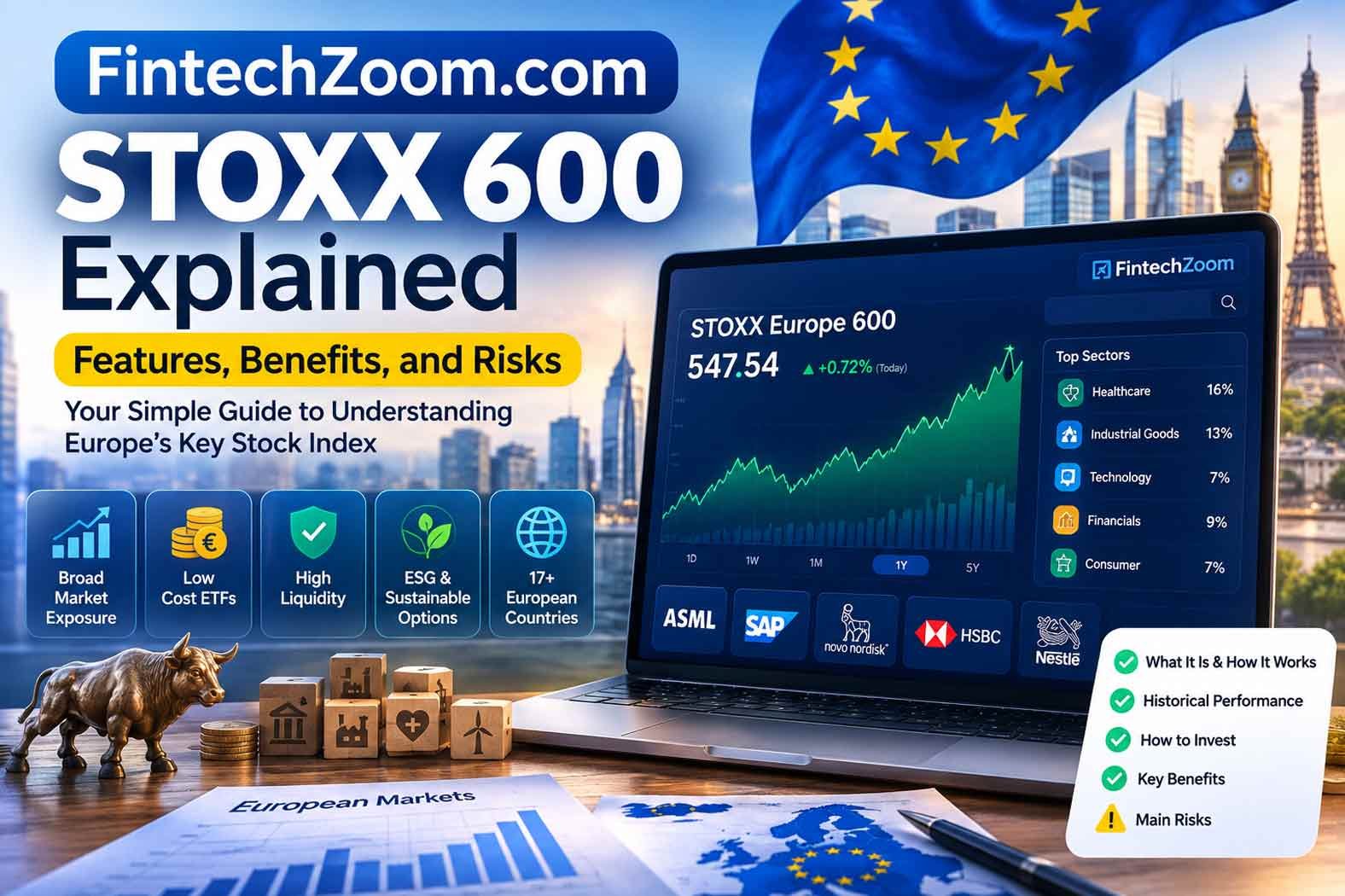
FintechZoom.com STOXX 600 is a search term used by people looking for information about the STOXX Europe 600 through the FintechZoom financial website. The STOXX Europe 600 is one of the main benchmarks used to follow the European stock market.
FintechZoom provides a page about the index with market information, charts, components, and investment-related explanations. However, FintechZoom does not create or manage the STOXX Europe 600. The official index is maintained by STOXX.
This guide explains what the index is, how it works, what information FintechZoom provides, the companies and markets it covers, and how investors can gain exposure to it.
What Is FintechZoom.com STOXX 600?
FintechZoom.com STOXX 600 is not a separate stock index. It generally refers to FintechZoom’s online information about the STOXX Europe 600 Index.
FintechZoom has a page called STOXX Europe 600 Index Overview (SXXP). The page includes information about the index and discusses ETFs and investing. It also provides access to a market chart through an embedded market data service.
This distinction is important. There are three separate things:
- STOXX creates and maintains the index.
- FintechZoom publishes financial information about it.
- ETFs and other investment products may be designed to follow its performance.
A reader using FintechZoom can learn about market movements, but official information about index rules, composition, and methodology should be checked through STOXX.
What Is the STOXX Europe 600 Index?
The STOXX Europe 600 is a broad European stock-market benchmark. It contains a fixed total of 600 companies from 17 developed European countries.
Unlike an index that follows only the biggest businesses, the STOXX Europe 600 includes:
- Large-cap companies
- Mid-cap companies
- Small-cap companies
This gives it wider coverage of the European market.
STOXX says the benchmark covers 11 industries and represents close to 90% of the underlying investable European market.
The index is European rather than European Union-only. Countries such as the United Kingdom and Switzerland are included even though they are not members of the European Union.
An index itself is not a company or stock. It is a group of securities used to measure the performance of part of a market. Investors who want similar exposure normally use a financial product designed to track the index.
How the STOXX 600 Works
The STOXX Europe 600 is designed to represent companies of different sizes across developed European markets.
The index is weighted using free-float market capitalization. In simple terms, this considers the value of shares that are actually available for public investors to trade. Larger companies normally have more influence on the index than smaller companies.
The index always aims to contain 600 components. Its membership does not stay the same forever. Companies can be added or removed as markets and company values change.
The official factsheet lists the review frequency as quarterly, with regular reviews in March, June, September, and December.
This means the index can change over time. A company that is important today may have a smaller weight later, while another company may grow and become more influential.
The same applies to sectors. Technology, healthcare, banks, industrial companies, energy businesses, and other industries can gain or lose weight as their market values change.
Main Features of FintechZoom.com STOXX 600 Coverage
FintechZoom’s STOXX Europe 600 page is mainly designed as an information and market-research page rather than an investment product.
Index Overview
The page gives readers a basic explanation of the STOXX Europe 600 and discusses ways people may gain market exposure through ETFs.
This can help beginners understand the general idea before researching individual investment products.
Charts and Market Data
FintechZoom’s page includes an embedded market chart. Charts can help users see whether an index has moved up or down over a selected period.
Readers should still check when the data was updated. Financial websites may use outside data providers, and prices may not always match the exact live price shown by a broker or exchange.
Index Components
FintechZoom also presents the page as a source for STOXX 600 components and related market information.
For official constituent information, STOXX is the stronger source because it maintains the benchmark itself.
STOXX 600 Countries, Sectors, and Major Companies
The STOXX Europe 600 covers 17 developed European countries and 11 industries, giving it much broader geographic exposure than a national index such as Germany’s DAX or the UK’s FTSE 100.
Its markets include major European economies such as France, Germany, the United Kingdom, Switzerland, Italy, Spain, and the Netherlands, along with several smaller European markets.
The benchmark also spreads its holdings across industries including healthcare, financial services, industrial businesses, technology, consumer companies, energy, utilities, and other sectors.
As of the official STOXX data checked in August 2026, the index’s top components included companies such as:
- ASML
- HSBC
- Roche
- Novartis
- Nestlé
- Shell
- AstraZeneca
- Siemens
- Banco Santander
- Schneider Electric
These holdings can change as share prices and index membership change.
For this reason, old articles should not be used to describe today’s exact company or sector weights.
How to Use FintechZoom to Track the STOXX 600
FintechZoom can be used as a starting point for following European stocks.
A reader can first open the STOXX Europe 600 page and look at the chart. Instead of focusing only on one day’s movement, it is useful to compare different periods and look for a broader trend.
Investors can also follow related European market news. Events such as interest-rate decisions, inflation reports, corporate earnings, economic growth, and geopolitical developments may influence European shares.
FintechZoom has also published separate European market articles that discuss STOXX 600 movements.
For important investment decisions, figures should be checked against official STOXX information, a regulated broker, or the fund provider. STOXX itself publishes index data, factsheets, methodology documents, and periodic review information.
STOXX 600 Performance and What Moves the Index
The STOXX Europe 600 moves according to the combined performance of its component companies.
Many factors can move the index. These include:
- Company earnings
- Interest rates
- Inflation
- Economic growth
- Energy prices
- Currency movements
- Trade policies
- Wars and political uncertainty
- Investor confidence
Large companies can have more influence because the benchmark is market-cap weighted.
The index has experienced both strong growth periods and major declines during events such as financial crises and the COVID-19 pandemic. This is normal for an equity index. Historical gains do not guarantee that prices will continue rising.
Old forecasts should also be treated carefully. For example, predictions made in 2025 about where the STOXX 600 might finish that year are no longer useful as current forecasts in 2026.
How to Invest in the STOXX Europe 600
Investors cannot normally buy the STOXX Europe 600 index itself. Instead, they can use investment products designed to follow its performance.
One common option is an exchange-traded fund, or ETF. An ETF can hold a group of securities and trade on a stock exchange in a similar way to a normal share.
A basic process is to choose a regulated brokerage that operates in your country, search for an ETF that tracks the STOXX Europe 600, and then read the fund’s official information before investing.
Important details include its fees, trading market, fund structure, dividend policy, and how closely it follows the index.
Other forms of exposure may include individual STOXX 600 stocks, index-related funds, futures, and options. STOXX confirms that ETFs, exchange-traded derivatives, and structured products exist around the benchmark.
Futures and options are more complex and can involve greater risk. Beginners should understand how these products work before considering them.
Part 2 continues with what to check before choosing a STOXX 600 ETF, its main benefits and risks, FintechZoom’s reliability, comparisons with other European indexes, and practical tips.
What to Check Before Choosing a STOXX 600 ETF
Not every STOXX Europe 600 ETF is exactly the same. Before investing, compare the fund details carefully.
The expense ratio or ongoing charge shows how much the fund costs each year. Lower fees can help long-term returns, but cost should not be the only factor.
Also check the fund’s size, trading volume, bid-ask spread, and tracking difference. Tracking difference shows how closely the ETF follows the STOXX Europe 600 after fees and other costs.
Another important point is how the ETF holds its investments. A physical ETF normally owns the underlying shares directly. A synthetic ETF may use financial contracts to copy the index’s performance.
Investors should also check whether dividends are:
- Distributed as cash payments.
- Accumulated and reinvested inside the fund.
Trading currency is also important, but it should not be confused with currency hedging. Buying an ETF that trades in euros, pounds, or dollars does not automatically remove currency risk from the underlying European companies.
Tax rules and ETF availability also depend on the investor’s country.
Benefits of STOXX 600 Exposure
One main benefit of the STOXX Europe 600 is diversification. Instead of depending on a few companies, the benchmark covers 600 large-, mid-, and small-cap companies from 17 developed European markets.
It also provides exposure to many industries. This means poor performance in one company or sector may have less effect than it would in a concentrated portfolio.
A STOXX 600 ETF can also be convenient. Investors can gain broad European market exposure through one fund instead of buying hundreds of separate stocks.
Another benefit is transparency. STOXX publishes information about its index methodology, components, and related data. This makes it easier for investors to understand what the benchmark is designed to track.
However, diversification reduces some risks. It does not prevent losses when the wider European stock market falls.
Risks and Drawbacks
Like any stock-market investment, STOXX 600 exposure comes with risk.
Market risk is the most basic concern. If European stock prices fall broadly, an ETF tracking the index can also lose value.
Economic conditions matter as well. Weak growth, high inflation, changing interest rates, or lower company profits can hurt European equities.
There is also currency risk. The STOXX Europe 600 covers companies from markets that use different currencies. International investors may therefore see their returns affected by exchange-rate movements.
Geopolitical events can also create uncertainty. Wars, sanctions, trade disputes, elections, and changes in government policy may affect particular European countries or industries.
An ETF brings its own smaller risks and costs. These can include:
- Management fees
- Tracking differences
- Trading spreads
- Liquidity differences
- Tax effects
Investors should therefore look beyond the index name before selecting a fund.
Is FintechZoom.com Reliable for STOXX 600 Information?
FintechZoom can be useful for reading financial news, market explanations, charts, and commentary. It can help readers understand what may be moving European markets.
However, it should not replace official investment documents.
FintechZoom itself states that information on its website is provided for informational purposes and should not be treated as financial or investment advice. Its terms also tell users not to rely on its content as professional financial advice.
For important facts, readers should use the most direct source available. For example:
- Check index rules and components with STOXX.
- Check ETF fees with the ETF provider.
- Check current trading prices with a broker or exchange.
- Check tax questions with an appropriate professional.
This is especially important for old FintechZoom.com STOXX 600 articles. Market prices, company weights, forecasts, and ETF fees can become outdated quickly.
FintechZoom vs Official STOXX Data
FintechZoom and STOXX serve different purposes.
FintechZoom is mainly a financial information and content website. It provides articles, market commentary, and research material for readers.
STOXX is the official index provider. It maintains the STOXX Europe 600 and publishes its rules, index information, components, and related documentation. The official benchmark currently has a fixed 600 components across 17 developed European countries and 11 industries.
For general explanations, FintechZoom may be a useful starting point. For official information about how the index works, STOXX should take priority.
Using both sources can be useful, as long as readers understand their different roles.
STOXX 600 vs Other European Indexes
The STOXX Europe 600 is sometimes confused with other major European indexes.
The EURO STOXX 50 is much narrower. It tracks 50 leading blue-chip companies from the Eurozone and uses free-float market capitalization for weighting.
The STOXX Europe 600 includes 600 companies from a wider group of European countries, including markets outside the Eurozone.
Other well-known indexes include:
- FTSE 100, focused on major companies listed in the UK.
- DAX, focused on major German companies.
- CAC 40, focused on major French companies.
The STOXX Europe 600 may therefore be more useful when someone wants a broad view of European equities rather than one country or only the largest Eurozone companies.
STOXX 600 ESG and Other Variants
STOXX also provides related indexes for investors interested in different strategies.
One example is the STOXX Europe 600 ESG-X. It is based on the standard STOXX Europe 600 but applies ESG exclusion screens. These screens are designed to remove certain companies based on environmental, social, governance, and business-activity criteria.
STOXX also offers other sustainability-focused versions, including the STOXX Europe 600 ESG Target.
These should not be confused with the normal STOXX Europe 600. They use different rules and may hold a different mix of companies.
Likewise, a fintech-focused STOXX index is a separate thematic product. It should not be described as another name for the STOXX Europe 600.
Tips for Using FintechZoom.com STOXX 600 Data
FintechZoom.com STOXX 600 information is more useful when it is treated as part of a wider research process.
A few simple habits can help:
- Check the date of every market figure.
- Compare short-term and long-term charts.
- Read why the market moved instead of looking only at the percentage change.
- Follow company earnings and European economic news.
- Watch major central-bank decisions.
- Verify official index information through STOXX.
- Check ETF fees directly with the fund company.
- Treat predictions as estimates, not guarantees.
Beginners should also avoid futures, options, and other complex products until they understand how the risks work.
Bottom Line
FintechZoom.com STOXX 600 mainly refers to FintechZoom’s information and coverage related to the official STOXX Europe 600 index.
The STOXX Europe 600 is a broad benchmark covering 600 companies across 17 developed European countries. It includes large-, mid-, and small-cap stocks, making it useful for tracking the wider European equity market.
Its main advantages are broad diversification and easy European market exposure through tracking funds. Its risks include market losses, economic weakness, currency movements, geopolitical events, and ETF-related costs.
FintechZoom can help with general research, but official STOXX documents and fund-provider information should be used when checking important investment details.
(FAQs)
Does FintechZoom own the STOXX 600?
No. STOXX maintains the official index. FintechZoom is a separate financial information website.
Can I invest directly in the STOXX 600?
You cannot normally buy the index itself. Investors usually gain exposure through ETFs or other financial products linked to the benchmark.
Is the STOXX 600 suitable for beginners?
Its broad diversification can make it easier to understand than choosing hundreds of individual European stocks. However, it can still fall in value, so beginners should understand the risks before investing.
What companies are in the STOXX 600?
The index contains 600 European companies. Its membership and company weights can change through regular reviews, so current holdings should be checked through STOXX.
What is the difference between STOXX 600 and EURO STOXX 50?
The STOXX Europe 600 covers 600 companies across a broad group of European markets. The EURO STOXX 50 focuses on 50 major blue-chip companies from the Eurozone.
Keep Reading:
NZBgeek Review: Features, VIG Pricing, Pros, and Cons








 Life Style1 year ago