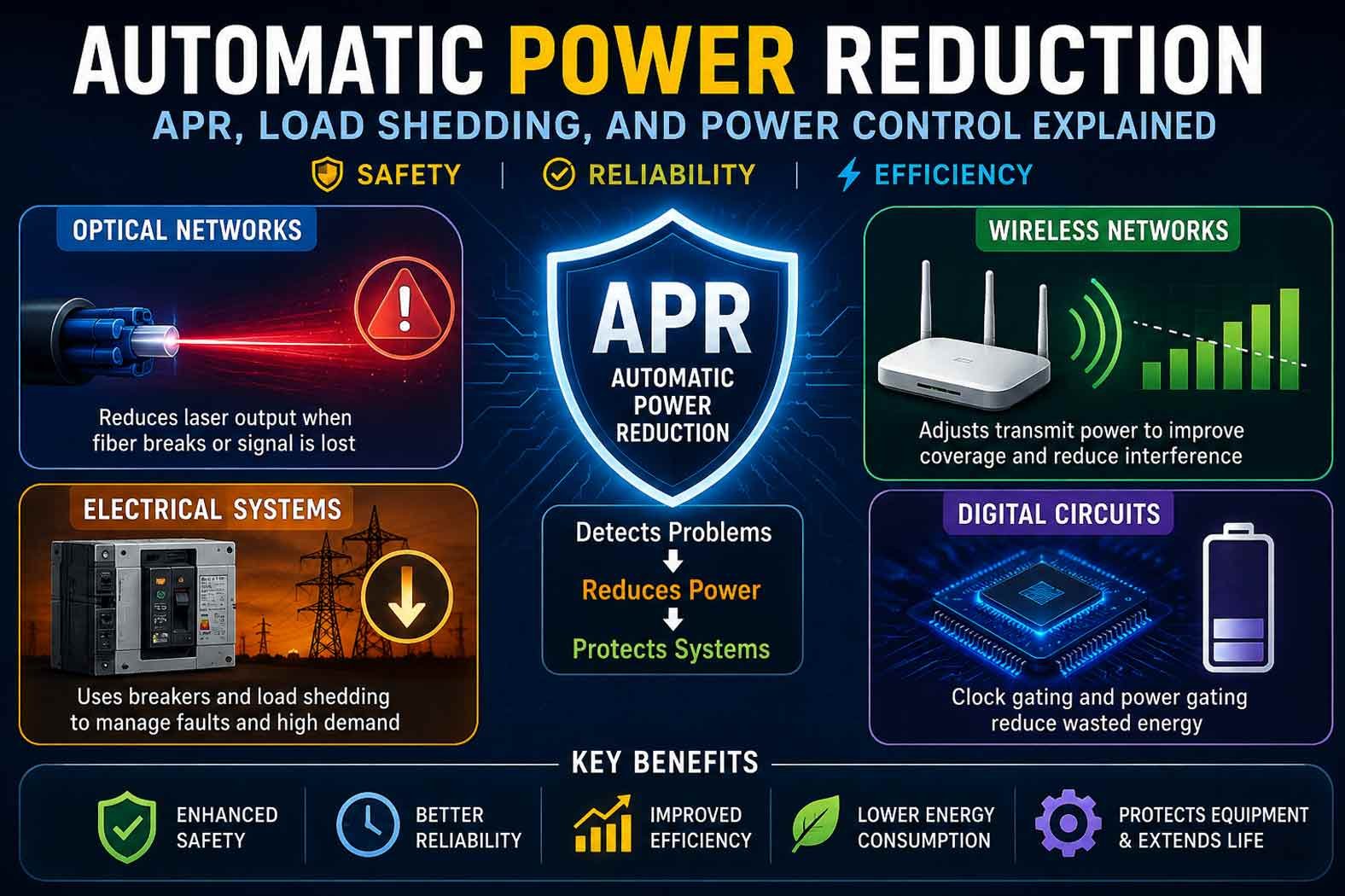
Automatic power reduction is a way for a system to lower or cut power when normal operation changes. It may react to a fault, overload, broken fiber connection, high demand, or changing network conditions.
People often search for automatic power reduction, or APR, because the term is used in several types of technology. It appears in optical networks, wireless systems, electrical power systems, and digital electronics.
This guide explains what APR means, how it works, how it protects equipment, and how related systems such as load shedding and vacuum circuit breakers control power automatically.
What Is Automatic Power Reduction?
Automatic power reduction is a control method that lowers, limits, or removes power without requiring a person to make the change manually.
In optical networks, APR may lower laser output when a fiber breaks or the signal suddenly disappears. This helps reduce the chance of unsafe optical energy escaping from an open connection.
The term can also have a wider meaning. Wireless systems may automatically change radio transmit power. Electrical systems may disconnect selected loads during an overload. Digital circuits may reduce power by stopping unused parts from switching.
These technologies are related because they all control power automatically, but they do not work in exactly the same way.
How Automatic Power Reduction Works
Most automatic power reduction systems follow a simple process.
First, sensors or monitoring tools check normal operating conditions. They may watch signal strength, current, voltage, load, frequency, or other values.
If a value moves outside a set limit, the system detects a problem. It then sends a command to lower power or disconnect part of the system.
In an optical network, for example, the process may look like this:
- The equipment monitors the optical signal.
- It detects a sudden signal drop or abnormal return loss.
- Output power is reduced to a safer level.
- Some systems send a low-power test signal before restoring normal output.
The source describes this process as monitoring, detecting, reducing, and sometimes probing for recovery.
The exact trigger and response depend on the equipment being used.
Automatic Power Reduction in Optical Networks
Automatic power reduction is especially important in high-power fiber-optic networks.
Optical communication equipment can use powerful infrared light. This light may not be visible to the human eye. If a fiber is broken or disconnected, high optical power could leave the normal closed path.
APR helps reduce this risk.
Common triggers may include:
- A broken fiber
- A disconnected connector
- Loss of signal
- Low or unusual return loss
- Other abnormal optical conditions
APR may be used with equipment such as optical transmitters, optical amplifiers, EDFAs, WDM systems, and long-distance fiber links.
When a problem is detected, the system lowers or stops optical output. This can protect technicians, connectors, cables, and nearby equipment.
The supplied material also refers to IEC 60825-1 in connection with laser safety. Exact safety requirements depend on the equipment, laser class, and system design.
APR in Ciena and Other Optical Equipment
The collected sources mention Ciena optical equipment as one example of APR use.
In systems such as the Ciena 6500, automatic power reduction may be linked with optical amplifiers and alarm conditions. A return-loss problem or another unusual optical condition may cause the system to reduce output.
Such alarms can also help network operators find a possible fiber or connector problem before it causes a larger issue.
APR behavior is not identical on every optical platform. Alarm names, trigger levels, and recovery steps depend on the manufacturer, hardware, and software version.
Automatic Power Control in Wireless Networks
Wireless networks use automatic power control for a different reason.
The main goal is usually not laser safety. Instead, wireless access points change their radio transmit power to improve coverage and control interference.
Using maximum radio power all the time is not always helpful. When several access points are close together, too much transmit power can increase overlap and interference.
An adaptive system can lower power when less is needed and increase it when conditions require more coverage.
The supplied sources use Cisco Meraki Auto RF and Auto TX Power as examples. Meraki access points can adjust radio power based on RF conditions.
Good settings may help provide:
- Better coverage balance
- Less channel overlap
- Lower interference
- Better use of nearby access points
However, setting power too low can create weak coverage areas. Automatic settings still need proper network planning and monitoring.
Optical APR vs. Wireless Power Control
Optical APR and wireless power control both change output automatically, but their main goals are different.
| Area |
Optical APR |
Wireless Power Control |
| Main goal |
Safety and protection |
Coverage and interference control |
| Common trigger |
Fiber break or signal problem |
Changes in RF conditions |
| Action |
Reduce or stop optical output |
Raise or lower radio power |
| Typical equipment |
EDFAs, optical links, transmitters |
Wi-Fi access points |
| Main benefit |
Safer optical operation |
Better wireless performance |
Optical APR is mainly safety-focused. Wireless power control is mainly focused on network performance and efficient radio use.
Keeping this difference clear is important because the same general idea of automatic power control is being used for different technical purposes.
Automatic Power Reduction and Load Shedding
In electrical power systems, automatic power reduction may involve load shedding.
Load shedding means disconnecting selected electrical loads when the system cannot safely supply everything at the same time.
For example, a plant or building may experience very high demand. Instead of allowing the whole system to become overloaded, the control system can remove less important loads first.
Loads may be grouped by priority.
Critical systems such as life-safety equipment or important production processes may remain online. Less important HVAC, comfort systems, or other non-essential loads may be disconnected first.
This controlled approach can reduce demand without causing a full blackout.
Load shedding can also be used when generators are close to their safe operating limit or when a power grid needs quick demand reduction.
How Vacuum Circuit Breakers Support Automatic Power Reduction
A Vacuum Circuit Breaker, or VCB, is commonly used in medium-voltage electrical systems.
It opens electrical contacts inside a sealed vacuum interrupter. Protection relays and sensors decide when the breaker should operate.
A typical VCB system may include:
- A vacuum interrupter
- Fixed and moving contacts
- An operating mechanism
- A protection relay
- Control wiring
- Auxiliary contacts
During normal operation, the contacts remain closed and carry current.
If the protection system detects an overload, short circuit, or another fault, it sends a trip command. The breaker opens and disconnects the affected circuit.
This automatically reduces the amount of connected load and helps stop the fault from spreading.
Overload Protection and Selective Tripping
An overload happens when electrical equipment carries too much current for too long. A protection relay can detect this condition and tell the breaker to open.
A short circuit usually requires an even faster response because very high fault current may flow.
Good electrical protection does not always disconnect the entire system. It uses selective tripping.
Selective tripping means the protection device closest to the problem should operate first when possible. For example, a downstream breaker may open while the main upstream breaker remains closed.
This keeps healthy parts of a building, plant, or network operating.
Correct relay settings are very important. Engineers must coordinate trip limits and time delays between upstream and downstream protection devices. Poor coordination can cause unnecessary outages or allow a fault to remain connected too long.
Stepwise Power Reduction and Demand Response
Some systems reduce power in several stages instead of removing many loads at once.
A simple setup may work like this:
- Stage 1 disconnects non-essential comfort loads.
- Stage 2 removes selected HVAC or production loads.
- Stage 3 keeps only the loads needed for safe operation.
Small time delays can be placed between the stages. This gives the system a chance to recover before more equipment is disconnected.
Automatic load control can also support demand response.
During a demand-response event, a utility or energy-management system may request lower electricity use. A building management system, PLC, EMS, or SCADA system can then disconnect selected non-critical loads.
When the high-demand period ends, those loads may be restored according to the control settings and safety rules.
Automatic Reclosing and Power Restoration
Some electrical systems can automatically restore power after a temporary fault.
This is called automatic reclosing.
A typical sequence is simple. The breaker opens when a fault is detected. It waits for a set period and then tries to close again.
If the fault has disappeared, normal operation may continue. If the problem is still present, the breaker can trip again or remain locked out.
Automatic reclosing is useful for temporary faults because it can reduce outage time and restore service without manual switching.
It is not suitable for every circuit or type of equipment. The reclose settings, number of attempts, delays, and lockout rules must match the system being protected.
SCADA, Smart Controls, and Remote Power Management
Automatic power reduction can work with modern control systems such as SCADA, PLCs, building management systems, and energy management systems.
These tools can monitor breakers, loads, alarms, and electrical conditions from one place. They may also send commands to open or close breakers when needed.
Common functions include:
- Remote breaker control
- Load shedding
- Alarm monitoring
- Event recording
- Power and demand monitoring
- Priority control for important loads
Smart VCB systems may support communication methods such as Modbus, IEC 61850, and DNP3.
Safety interlocks are still important. Remote controls should not allow automatic commands to bypass maintenance locks or other safety rules.
Other Power Reduction Methods: Clock Gating and Power Gating
Digital electronics use different methods to reduce wasted power.
Clock gating stops the clock signal from reaching parts of a circuit that are not being used. This reduces unnecessary switching.
A common dynamic power formula is:
Pdynamic = α × C × V² × f
Here, α is switching activity, C is capacitance, V is voltage, and f is clock frequency. Clock gating mainly lowers switching activity.
Power gating works differently. It cuts the supply voltage to an inactive part of a circuit.
Clock gating and power gating are useful power-saving methods, but they are not the same as optical APR or electrical load shedding.
Automatic Power Reduction vs. Automatic Power-Off
Automatic power reduction does not always mean shutting equipment down completely.
APR may lower output to a safer level while keeping part of the system active. Load shedding may disconnect only selected loads.
Automatic power-off normally stops the affected equipment completely.
A full shutdown may be used when a fault is serious or continues for too long.
The best action depends on the type of equipment and the safety requirements.
Automatic Power Reduction vs. Power Factor Correction
Automatic Power Factor Correction, or APFC, is another electrical term that can be confused with APR.
APFC manages reactive power to improve the power factor of an electrical system. It often uses capacitors or other correction equipment.
A formula included in the collected material is:
Qc = P × (tan φ₁ − tan φ₂)
APFC can improve electrical efficiency, but it is not the same as automatic power reduction. It belongs mainly to power-quality management.
Benefits of Automatic Power Reduction
The benefits of automatic power reduction depend on where it is used.
In optical networks, APR can lower dangerous optical output after a fiber or signal problem. This helps protect people and equipment.
In wireless networks, automatic transmit-power control can reduce interference and improve coverage balance.
In electrical systems, selective tripping and load shedding can keep healthy parts of a facility operating while isolating a fault.
APR may also help reduce unnecessary energy use, heat, equipment stress, and downtime. The actual savings depend on the equipment and its settings.
Limitations and Possible Problems
Automatic power reduction has limits.
It cannot repair a broken fiber, damaged cable, failed breaker, or other physical problem. It only reacts to the condition.
Poor settings can also create problems. A wireless access point set too low may leave weak coverage areas. A poorly coordinated breaker system may disconnect more equipment than necessary.
Sensors, relays, control wiring, communication systems, and trip coils can also fail.
Automatic reclosing must be used carefully because some faults should not be energized again automatically.
APR also does not replace regular inspection and maintenance.
Common APR and Power-Control Problems
Optical APR Activates Unexpectedly
Unexpected APR alarms may be caused by signal loss, damaged fiber, loose connectors, or unusual return loss.
Check the fiber path, connectors, optical signal readings, and alarm logs. Repair the physical problem before trying to restore full output.
Wireless Performance Gets Worse
Automatic radio power settings can sometimes produce poor coverage.
Check RF interference, access-point placement, minimum and maximum transmit-power limits, and coverage measurements.
VCB Fails to Trip
A vacuum circuit breaker may fail to operate because of a bad trip coil, missing control power, faulty wiring, or a relay problem.
Test the trip circuit and protection relay before returning the system to service.
Breaker Will Not Reclose
Possible causes include an active fault, undervoltage, a safety interlock, or blocked reclosing logic.
The fault should be found before forcing the breaker closed.
Nuisance Trips
Nuisance trips may be caused by incorrect relay settings, motor starting current, transformer energization, harmonics, or short power spikes.
Relay logs and event records can help identify the real cause.
APR Best Practices
Automatic power reduction works best when it is properly configured and tested.
For optical networks, inspect fiber links and monitor APR-related alarms.
For wireless systems, use sensible transmit-power ranges and check real RF coverage instead of always using maximum power.
For electrical systems, coordinate upstream and downstream protection devices. Test trip settings, load-shedding stages, automatic reclosing, and safety interlocks.
Keep control diagrams, breaker settings, and system documentation updated. Event logs should also be reviewed after important faults or power-reduction events.
Where Automatic Power Reduction Is Used
Automatic power reduction and related power-control methods are used in many systems, including:
- Fiber-optic networks
- Optical amplifiers and long-distance links
- Wi-Fi networks
- Data centers
- Industrial plants
- Commercial buildings
- Hospitals
- Generator systems
- Utility substations
- Medium-voltage feeders
- Smart grids
- Microgrids
- Battery and renewable-energy systems
- Digital processors and ASICs
The exact technology changes with the application. An optical network does not use APR in the same way as an electrical power system.
Future of Automatic Power Control
Power-control systems are becoming more connected and data-driven.
The collected material points to increased use of digital breakers, built-in metering, remote monitoring, event recording, and condition monitoring.
Smart systems may also work more closely with:
- Battery storage
- Solar and wind systems
- Microgrids
- EV charging
- Demand-response programs
- Predictive maintenance tools
More equipment may use live data to decide which loads to reduce and when maintenance is needed. These are technology trends rather than features available in every current system.
Bottom Line
Automatic power reduction is a broad idea used to control power automatically when operating conditions change.
In optical networks, APR mainly reduces unsafe laser output. In wireless networks, adaptive power control helps manage coverage and interference. Electrical systems use breakers, protection relays, and load shedding to isolate faults and control demand.
Related methods such as clock gating reduce wasted power in digital circuits.
APR can improve safety, reliability, and efficiency, but it depends on correct settings, testing, monitoring, and regular maintenance.
(FAQs)
What triggers APR in optical networks?
Common triggers include fiber breaks, signal loss, connector problems, and abnormal optical conditions.
Is APR the same as turning equipment off?
APR may only reduce output. Automatic power-off stops operation completely.
What is load shedding?
Load shedding is the controlled removal of selected electrical loads to reduce demand or protect a power system.
Can automatic power reduction improve Wi-Fi?
Adaptive transmit-power control can help reduce interference and balance coverage when it is configured correctly.
Is clock gating the same as APR?
Clock gating is a digital power-saving technique that stops unnecessary clock switching in idle circuits.
Does APR replace regular maintenance?
APR helps protect systems, but regular testing, inspection, and maintenance are still necessary.








 Life Style1 year ago