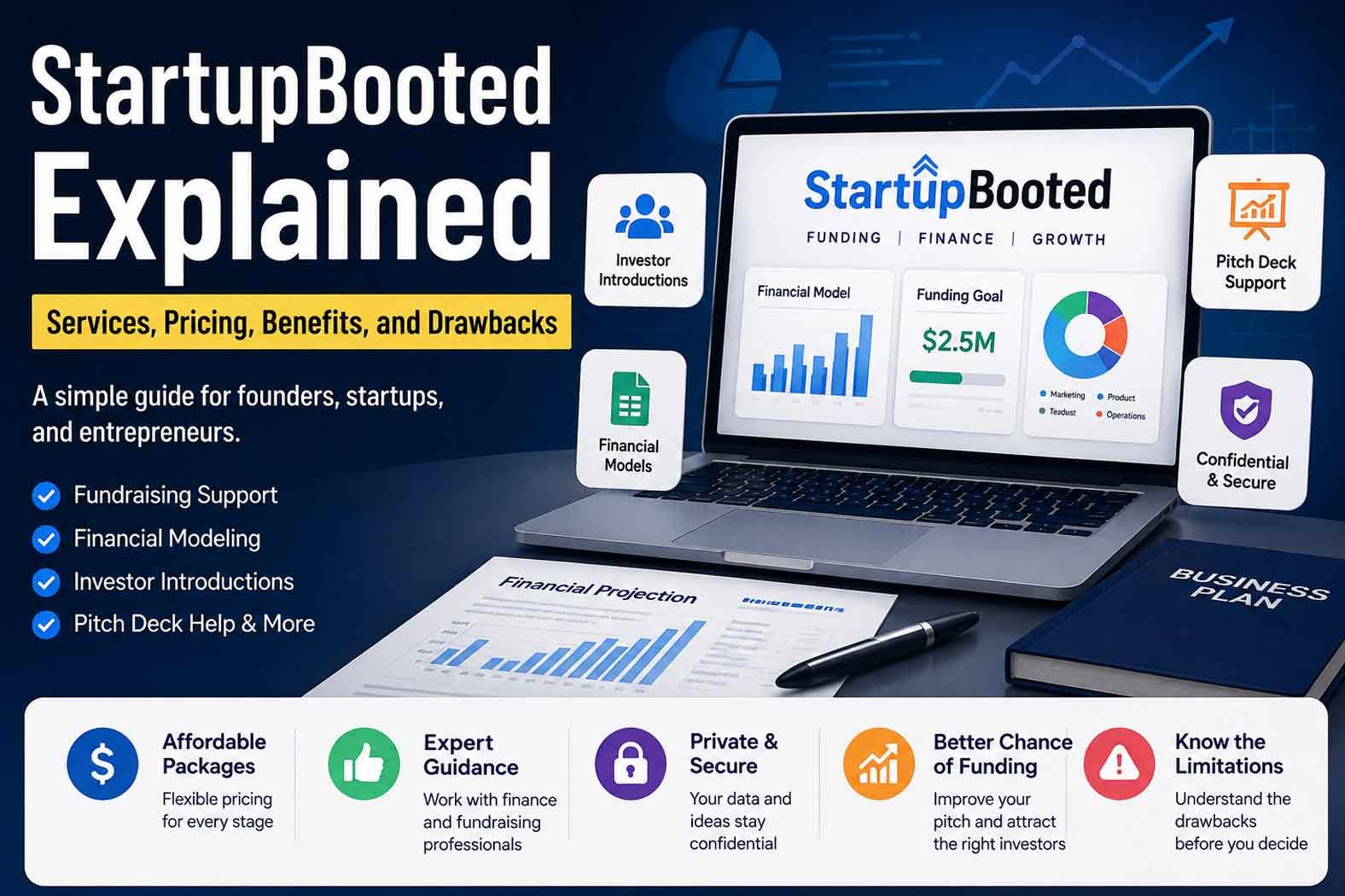
StartupBooted is a startup consulting service that helps founders with fundraising, financial planning, budgeting, and investor pitch decks. People may search for StartupBooted when they need professional help preparing their business for investors or planning future growth.
The name can also be confused with the general idea of a “bootstrapped” startup. In this article, StartupBooted refers mainly to the consulting service. We will also explain the fundraising and financial ideas connected with its approach.
What Is StartupBooted?
StartupBooted is a professional service for startup founders. It focuses on areas that are often important before a company raises money.
Its main work includes financial modeling, fundraising planning, budgeting, and creating investor presentations.
StartupBooted is not mainly presented as a software platform. There is no confirmed dedicated Android, iPhone, Windows, or Mac application. Its public information focuses more on consulting services provided to businesses.
The service may be useful for founders who do not have an experienced finance or fundraising person on their team.
The exact founder, owner, and current leadership team are not clearly identified on the public pages we reviewed. Its exact launch date is also not confirmed. A copyright notice alone is not enough to prove when the business started.
It is also important not to confuse StartupBooted with normal startup bootstrapping. Bootstrapping means building a business mainly with the founder’s own money and customer revenue. StartupBooted offers professional services connected with some of these ideas.
What Services Does StartupBooted Offer?
StartupBooted provides several services aimed at helping startups become better prepared for growth and fundraising.
Its main services include investor pitch decks, financial modeling and budgeting, and fundraising strategy.
The company says its work is customized for each business. This means it is different from buying a simple ready-made spreadsheet or software subscription.
For example, a founder may need help showing investors how the company makes money. Another startup may already have a good product but need a clearer fundraising plan. StartupBooted offers services for both situations.
Its work can also include business planning, financial analysis, market research, and general startup strategy.
StartupBooted Investor Pitch Deck Service
A pitch deck is a short presentation that founders use when speaking with potential investors. It normally explains the company’s problem, solution, market, business model, progress, team, and financial opportunity.
StartupBooted offers customized pitch-deck development.
The service focuses on making the information easier for investors to understand. This can include improving the structure of the presentation, simplifying the story, and presenting important numbers more clearly.
Visual design is also part of a strong pitch deck. Charts, slides, and key facts need to be easy to read. The purpose is not simply to make a deck look attractive. It should help investors quickly understand what the startup does and why it may have growth potential.
StartupBooted’s investor pitch-deck service currently starts at $5,000. This is a starting price. The final cost may depend on the amount of work and the needs of the startup.
StartupBooted Financial Modeling and Budgeting
Financial modeling is another major StartupBooted service.
A startup financial model is a set of calculations that shows how a business may perform in the future. It normally uses assumptions about sales, customers, prices, costs, hiring, and growth.
StartupBooted says its financial modeling service can help founders with budgeting, financial planning, and different business scenarios.
A useful model may include revenue, direct costs, operating expenses, profit, cash flow, and the company’s balance sheet.
Cash flow is especially important for a small startup. A company can show profit on paper while still having very little cash available.
For example, a customer may agree to pay a large invoice but take 60 or 90 days to send the money. The startup may still need to pay salaries and other bills before that payment arrives.
A financial model can help founders see this type of problem earlier.
StartupBooted’s financial modeling and budgeting service currently starts at $10,000.
What Is Startup Booted Fundraising Strategy?
A Startup Booted fundraising strategy is based on building business value before depending heavily on outside investors.
The basic idea is simple. A founder first tries to prove that customers want the product. The startup then uses early revenue to improve the business and grow carefully.
This does not mean investors should always be avoided.
Instead, the goal is to raise outside money when the business has already shown signs that its model works. This can give founders more choice when speaking with investors.
A revenue-first approach can also reduce early ownership dilution. When founders raise venture capital, they normally give investors part of the company in return for money.
Bootstrapping allows founders to keep more control, but it can also mean slower growth because less money is available.
The best approach depends on the business. Some companies can grow from customer revenue. Others need large amounts of money before they can launch or compete.
How the StartupBooted Fundraising Approach Works
The process normally starts with customer validation.
Before spending heavily, founders should find out whether people actually have the problem their product is trying to solve. Customer interviews, landing pages, early sales, pre-orders, and letters of intent can help test demand.
The next step is usually a minimum viable product, or MVP. This is a simple version of the product that solves the main customer problem without unnecessary features.
After getting early customers, the startup can use some of its revenue to improve the product, attract more customers, and automate work.
Retention also matters. Getting many new customers does not help much if they quickly leave.
Once the startup has stronger revenue and a proven business model, founders can decide whether outside funding is needed.
They may consider venture capital, angel investors, strategic partners, grants, or other forms of financing.
The main idea is to raise money because it can speed up a working business, rather than raising money simply because the company cannot survive without it.
Important Financial Metrics for Startups
Startup founders need to understand a few basic financial numbers.
Monthly Recurring Revenue (MRR) is predictable monthly income from subscriptions or recurring contracts. It is especially useful for SaaS companies.
Customer Acquisition Cost (CAC) shows how much a company spends to gain one new customer.
The basic formula is:
Sales and marketing costs ÷ New customers acquired
Customer Lifetime Value (LTV) estimates how much value a customer may bring during the full relationship with the company.
Founders often compare LTV with CAC. A commonly mentioned target is around 3:1, meaning the expected customer value is about three times the cost of acquiring that customer. This is a useful guideline, not a rule for every business.
Churn measures customers or revenue that the business loses.
Burn rate shows how quickly a startup is spending its available cash.
Runway estimates how long the business can continue before its available cash runs out.
These numbers help founders understand whether growth is healthy or expensive.
Bottom-Up Financial Forecasting
Bottom-up forecasting starts with real business activity instead of making a large market-size prediction.
For example, a startup may estimate:
- How many people visit its website
- How many start a trial
- How many become paying customers
- How much each customer pays
- How many customers leave
Suppose a website gets 10,000 visitors. If 5% start a trial, that gives 500 trials. If 10% of those users become paying customers, the business gains 50 customers.
If each customer pays $50 per month, the startup adds $2,500 in monthly recurring revenue.
This type of forecast makes it easier to understand where growth comes from.
A top-down forecast may simply say the company will capture 1% of a large market. That may look impressive, but it does not explain how customers will actually be gained.
Building a Useful Startup Financial Model
A good startup financial model should be simple enough to update regularly.
One useful method is to keep the main assumptions in one place. These may include product price, customer growth, conversion rates, churn, marketing costs, salaries, and starting cash.
The model can then calculate future revenue and expenses from those assumptions.
It should also include direct costs. For a SaaS company, these may include hosting or payment processing. Other startups may have manufacturing, delivery, or inventory costs.
Operating costs can include salaries, contractors, advertising, software, legal fees, accounting, and office expenses.
Timing is also important.
If a customer pays for a yearly subscription in advance, cash may arrive immediately even though accounting revenue is recognized over a longer period.
A useful model should therefore look at both profit and cash.
Founders should also compare forecasts with actual results. If sales, costs, or churn are different from expected, the model should be updated.
Scenario Planning for Bootstrapped Startups
A financial model is only an estimate. Actual business results can be better or worse.
Scenario planning helps founders prepare for different possibilities.
A base case shows the result the founder believes is most realistic.
A best case shows what may happen if sales or customer growth are stronger than expected.
Fast growth can still create problems. A company may suddenly need more staff, servers, inventory, or customer support before enough new cash arrives.
A worst case may assume weaker sales, higher churn, rising costs, or the loss of an important marketing channel.
Planning these situations in advance can help founders decide where they could reduce spending if the business has problems.
StartupBooted includes scenario analysis as part of its financial modeling approach.
StartupBooted Pricing
StartupBooted is mainly a paid consulting service.
The current starting prices we found are:
| Service |
Starting Price |
| Fundraising strategy |
$2,000 |
| Investor pitch deck |
$5,000 |
| Financial modeling and budgeting |
$10,000 |
These are starting prices, not fixed prices for every project.
The final amount may depend on the startup’s size, needs, and the amount of work required.
Startup founders should ask what is included before buying a service. Important details may include the number of revisions, final files, project scope, support, and expected delivery process.
The public information we reviewed does not clearly give one fixed price for every possible StartupBooted project.
Is StartupBooted Free or Paid?
StartupBooted is mainly a paid consulting service. Its main services, including fundraising strategy, pitch decks, and financial modeling, have starting prices.
Its Terms mention that subscriptions or free trials may sometimes be offered. However, we did not confirm a permanent free plan that anyone can use.
Some third-party articles also mention a free Startup Booted financial model template. We could not clearly confirm that this template is currently offered by StartupBooted itself.
Readers should therefore not assume that StartupBooted’s professional financial modeling service is free.
StartupBooted Refund Policy
StartupBooted’s Terms describe its products as digital and state that refunds are not provided under its listed refund policy.
This is important because some StartupBooted services can cost thousands of dollars.
Before paying, founders should confirm:
- What work is included
- How many revisions are included
- What final files they will receive
- How communication will work
- Any extra costs
Users should also read the latest Terms before making a purchase because policies can change.
StartupBooted Privacy and Data Collection
StartupBooted has a privacy policy explaining the information it may collect.
This can include a person’s name, email address, phone number, address, IP address, device details, browser information, and usage data.
The site may also use cookies. These can include session, preference, security, and advertising cookies.
Tracking tools such as tags and scripts may also be used to understand how visitors use the service.
StartupBooted says some information may be used to send newsletters, offers, or information about related services. Users can choose to stop receiving marketing messages.
Data Security and Third-Party Services
StartupBooted says it uses commercially acceptable methods to protect personal information.
However, it does not claim that internet data can be protected with 100% certainty. This is normal for online services because no internet system can promise complete security.
Third-party companies may also help StartupBooted with services such as payments, analytics, advertising, and other business operations.
Payment card information may be handled directly by payment processors instead of being stored by StartupBooted itself.
Its privacy policy also states that information provided from outside India may be transferred to and processed in India. This does not prove that India is the company’s legal headquarters.
User Rights and Legal Terms
StartupBooted says its service is intended for people aged 18 or older.
Users are responsible for protecting their account details and passwords where accounts are used.
The Terms also prohibit activities such as fraud, malware, impersonation, unauthorized access, and attempts to damage the service.
The privacy policy discusses rights that may apply to users in certain regions. These include GDPR rights for people in the European Economic Area and some privacy rights for California residents.
StartupBooted also provides its service on an “as available” basis. It does not guarantee that a founder will raise money, receive a certain valuation, become profitable, or attract a specific investor.
Benefits of StartupBooted
StartupBooted may be useful for founders who need professional help in areas they do not understand well.
Possible benefits include:
- Help creating financial forecasts
- Better startup budgeting
- Professional investor pitch-deck support
- Structured fundraising planning
- Scenario planning
- Help understanding cash flow and runway
- Customized work instead of a basic template
A good financial model can also help founders understand how hiring, marketing, pricing, or customer loss may affect their cash.
The main benefit is professional support. Results still depend on the startup, its product, market, team, and financial condition.
Drawbacks and Limitations
The biggest limitation for some founders is cost.
StartupBooted’s services start in the thousands of dollars. A very small startup may not have enough money to justify professional consulting at this stage.
Other limitations include:
- No guarantee of successful fundraising
- Limited public information about the founder or leadership team
- No clearly confirmed permanent free plan
- No confirmed mobile or desktop app
- No clearly listed integrations with tools such as QuickBooks, Xero, or Salesforce
- Project timelines are not clearly shown in the public information we reviewed
- The Terms include a no-refund statement for digital products
Founders should compare the cost with other options before buying.
Bootstrapping vs Venture Capital
Bootstrapping means growing a company mainly with founder money and customer revenue.
Venture capital works differently. Investors give the company money in return for ownership, usually through equity.
Bootstrapping can help founders keep more control. They may also keep a larger share of their company.
The disadvantage is slower growth. A bootstrapped startup may have less money for staff, advertising, technology, and expansion.
Venture capital can provide much more money quickly. It may be useful when a company must grow fast or spend heavily before it can make enough revenue.
Neither method is always better.
A small SaaS or service company may be able to grow through customer revenue. A company building expensive hardware or large infrastructure may need outside funding much earlier.
Other Funding Options for Startups
Founders do not have to choose only between bootstrapping and venture capital.
Revenue-based financing provides money that is repaid using a share of future revenue. It usually does not require the same type of equity exchange as VC funding.
Angel investors are individuals who invest their own money in startups. Some also provide advice and business contacts.
Strategic partnerships can provide money, customers, technology, or distribution.
Some companies may also qualify for grants, startup competitions, accelerators, bank loans, or lines of credit.
Customer prepayments can sometimes help as well. A business may sell annual plans, pre-orders, or early access before spending heavily on development.
Each option has different costs and risks.
Common Mistakes Bootstrapped Founders Should Avoid
One common mistake is spending money before proving that customers want the product.
Hiring too quickly can also cause cash problems. A new employee creates a regular cost even when sales slow down.
Founders should also avoid building too many features before understanding what customers actually need.
Financial mistakes can be just as serious. A startup should track cash flow, customer churn, expenses, and payment timing.
Forecasts should also stay realistic. Predicting huge growth without explaining where new customers will come from does not make the business stronger.
A financial model should be updated with real results instead of being created once and forgotten.
Who Should Consider StartupBooted?
StartupBooted may make sense for founders who are preparing to raise money and need professional support.
It may also help startups that need a detailed financial model, stronger budgeting, or an investor-ready pitch deck.
The service may be more suitable for companies that already have enough budget to pay for consulting.
A founder who is still testing a very early idea may be better served by a simple spreadsheet, startup mentor, accelerator, or lower-cost consultant first.
StartupBooted also does not replace licensed legal, tax, or accounting professionals when specialized advice is required.
Bottom Line
StartupBooted is a paid startup consulting service focused on fundraising strategy, investor pitch decks, financial modeling, and budgeting.
It may be useful for founders who need professional help preparing financial information or presenting their company to investors.
Its services are not cheap, so early-stage founders should consider whether the expected value fits their budget.
StartupBooted also cannot guarantee funding or business success.
Before paying, founders should check the latest pricing, privacy policy, refund terms, project scope, and deliverables.
It is also important to remember that StartupBooted is a consulting service. General advice about bootstrapping or “startup booted” financial models found on other websites should not automatically be treated as an official StartupBooted service.
(FAQs)
How much does StartupBooted cost?
Based on the information collected, fundraising strategy starts at $2,000, investor pitch decks start at $5,000, and financial modeling and budgeting start at $10,000.
Is StartupBooted free?
Its main consulting services are paid. A permanent public free plan has not been clearly confirmed.
Does StartupBooted offer a free financial model template?
A third-party article describes a Startup Booted free financial model template. However, we did not clearly verify a current official free template from StartupBooted itself.
Is StartupBooted safe to use?
StartupBooted has a privacy policy and says it uses commercially acceptable security measures. However, like other online services, it cannot guarantee complete security.
Does StartupBooted guarantee startup funding?
No confirmed information shows that StartupBooted guarantees funding. Fundraising results depend on many factors, including the business, market, traction, finances, and investors.
Who is StartupBooted best for?
It may be useful for startup founders who need professional help with financial planning, fundraising preparation, budgeting, or pitch decks.








 Life Style1 year ago