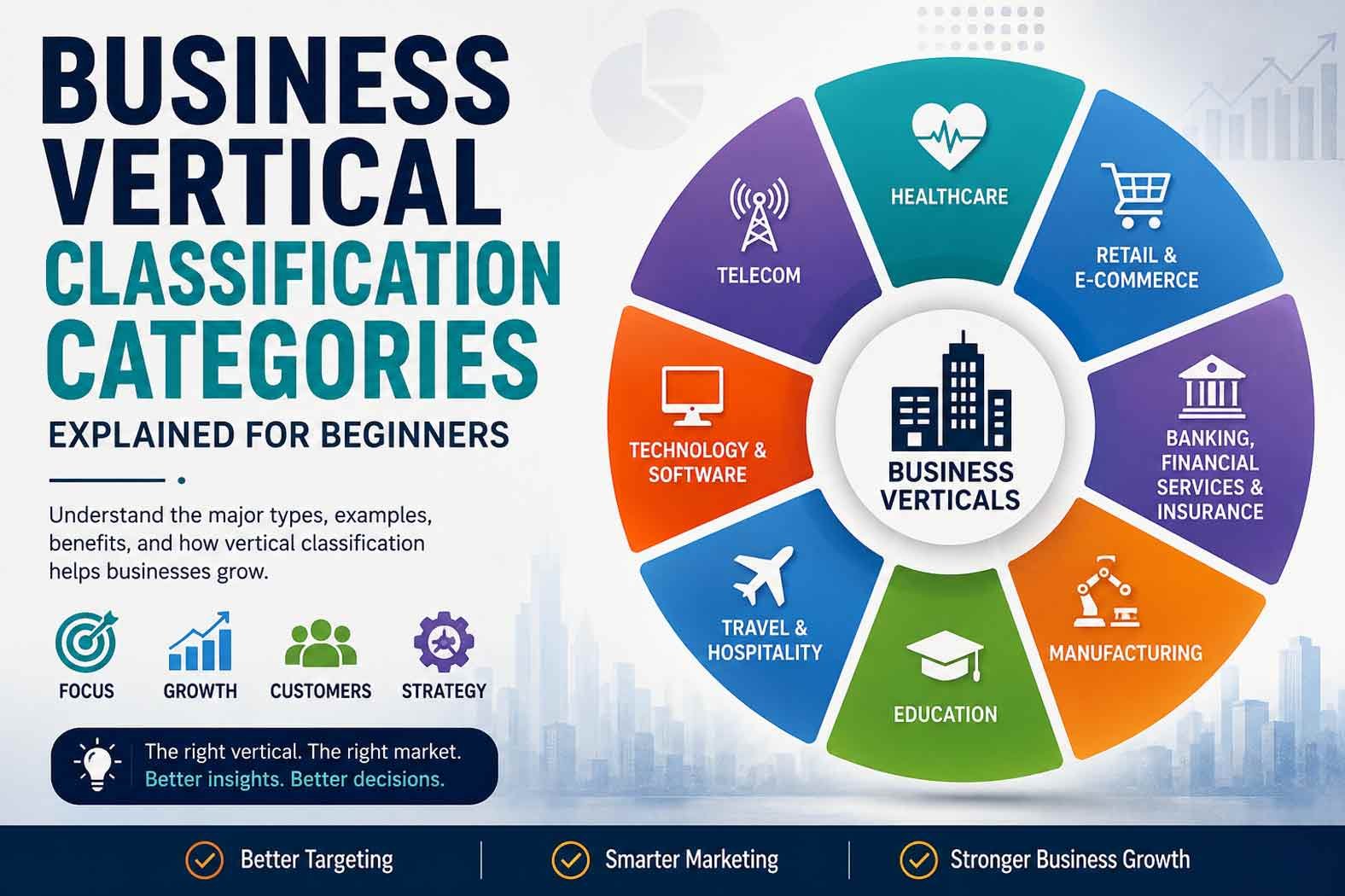
Business vertical classification categories help organize companies by the markets and industries they serve. A business may belong to technology, healthcare, finance, retail, manufacturing, real estate, or another vertical. It may also fit into a smaller category such as FinTech, HealthTech, or PropTech.
People use these classifications for market research, competitor analysis, marketing, investing, and business planning. Official systems such as NAICS and GICS also provide standard ways to group businesses for statistics or investment analysis.
This guide explains what business verticals are, how they differ from industries and sectors, and how major classification systems work.
What Are Business Vertical Classification Categories?
A business vertical is a specific market or industry area in which a company operates. Business vertical classification means placing companies into groups that share similar business activities, products, services, customers, or market needs.
For example, a company that provides software to hospitals can be described as part of the healthcare technology vertical. A company offering digital payment services may fall under FinTech.
Businesses can be classified using several factors, including:
-
Their main products or services
-
The customers they serve
-
Their main source of revenue
-
The problems their products solve
-
Their industry
-
Their business model
-
The regulations that apply to their activities
There is no single universal list of business vertical classification categories. The correct category often depends on why the classification is being used.
A government statistical agency may classify a company according to its main economic activity. An investor may use an investment-sector system. A marketing team may use a much narrower label based on the company’s customers.
This is why a company may have an official industry code while also describing itself using terms such as SaaS, FinTech, HealthTech, or e-commerce.
Business Vertical vs Industry vs Sector
The words sector, industry, and vertical are often used together, but they can describe different levels of a market.
A sector is usually a broad part of the economy. Technology, healthcare, energy, and financial services are common examples.
An industry is normally more specific. The technology sector, for example, can contain software, semiconductor, IT service, and hardware industries.
A vertical can be narrower again. It may focus on one type of customer or one specialized market.
A simple example is:
Technology → Software → Healthcare Software → Dental Practice Software
In this example, technology is broad. Software is more specific. Healthcare software serves one industry, while dental practice software focuses on an even smaller market.
There is no rule that every business discussion must use these words in exactly the same way. In everyday business language, “industry” and “vertical” are sometimes used interchangeably. Formal classification systems, however, normally have clearly defined levels.
Vertical Markets vs Horizontal Markets
A vertical market focuses on the needs of one industry or a closely related group of customers.
For example, software made specifically for law firms may include case management, legal billing, document tools, and features designed around legal work. A hospital management platform may include patient, clinical, and healthcare administration functions.
A horizontal market works differently. A horizontal product is designed to serve customers in many industries.
Cloud storage is a simple example. Doctors, retailers, manufacturers, accountants, and other businesses may all use the same basic cloud-storage service.
The main differences are:
Vertical MarketHorizontal MarketFocuses on a specific industryServes many industriesUses industry-specific featuresUses broader featuresTargets a narrower customer groupTargets a wider customer groupOften requires specialist knowledgeUsually aims for broad usabilityMay have a smaller marketCan reach a much larger market
Neither approach is automatically better.
A vertical company may understand its customers more deeply and create highly specialized products. However, it can also depend heavily on the performance of one industry.
A horizontal company can reach more types of customers, but it may face more competition from other general-purpose products.
The technology itself does not always decide the vertical. Two companies could use similar software or payment technology while serving completely different industries.
Why Business Vertical Classification Matters
Correct classification makes it easier to understand where a company fits in the market.
For marketing, vertical classification helps businesses identify the language, problems, and priorities of their customers. Marketing healthcare software to hospitals, for example, requires different information from marketing retail software to online stores.
It also improves competitor research. A company can compare itself with businesses serving similar customers instead of comparing itself with every company using the same technology.
Verticals are also useful for investors. Companies operating in similar markets often face similar economic conditions, regulations, and business risks. Investment classification systems such as GICS help investors compare companies and study exposure to different parts of the economy.
Classification can also support product development. When a company clearly understands its vertical, it can focus on problems that matter to customers in that market.
It may also help with compliance research. Healthcare, finance, transportation, food, and other industries can face different rules. However, an industry label or classification code does not by itself decide which laws apply. Legal requirements depend on the company’s actual activities, location, products, customers, and data use.
Main Business Vertical Classification Systems
Several formal systems are used to organize businesses and industries. They do not all serve the same purpose.
NAICS
The North American Industry Classification System (NAICS) is used by U.S. federal statistical agencies to classify business establishments for collecting and analyzing economic data.
NAICS was adopted in 1997 and replaced the older SIC system for this purpose. It was developed jointly by statistical authorities in the United States, Canada, and Mexico to improve the comparability of North American business statistics.
NAICS categories become more detailed as the code becomes longer. Businesses can therefore move from a broad economic sector to a much more specific activity.
NAICS is normally reviewed every five years. As of August 2026, the U.S. Census Bureau still provides 2022 NAICS as the current searchable classification while work on proposed updates for the 2027 revision is underway.
SIC
The Standard Industrial Classification (SIC) is an older system for organizing business activities.
NAICS replaced SIC as the main U.S. federal statistical classification system, but SIC has not completely disappeared. Some government records, older databases, and other systems still contain SIC codes. OSHA, for example, continues to provide access to the 1987 SIC Manual and allows users to search its two-, three-, and four-digit classifications.
For current U.S. statistical classification, NAICS is generally more relevant. SIC can still be useful when working with older records or systems that continue to use it.
GICS
The Global Industry Classification Standard (GICS) is mainly designed for investment research and financial-market analysis.
It was created in 1999 by S&P Dow Jones Indices and MSCI. It groups companies into four levels:
Sector → Industry Group → Industry → Sub-Industry
GICS is used by investors, asset managers, index providers, and analysts to compare companies, measure sector performance, study portfolio exposure, and analyze risk. It is reviewed regularly to reflect changes in global markets.
As of 2026, GICS has 11 sectors at its broadest level. Its structure then becomes increasingly detailed at the industry-group, industry, and sub-industry levels.
Unlike NAICS, which is mainly tied to economic statistics, GICS is strongly focused on investment analysis.
NIC and Other National Systems
Countries outside North America may use their own official industry classification systems.
India uses the National Industrial Classification (NIC) maintained by the Ministry of Statistics and Programme Implementation. Older sources often refer to NIC 2008, but India’s ministry now also provides NIC 2025 and a current NIC 2025 code finder.
National systems are important because official business classifications are not identical in every country. A company operating internationally may therefore need to compare or map categories across several systems.
This is also why terms such as technology, FinTech, retail, or SaaS should not be confused with one universal official business code. Formal classifications and everyday business vertical labels often serve different purposes.Major Business Vertical Categories
Business vertical classification categories can cover broad industries or smaller specialized markets. The following are some of the most common examples.
Technology and IT
This vertical includes software development, cloud computing, cybersecurity, artificial intelligence, IT consulting, outsourcing, SaaS, and enterprise software. Technology also overlaps with many other industries.
Healthcare and Life Sciences
Healthcare includes hospitals, clinics, pharmaceuticals, biotechnology, medical devices, telemedicine, and digital health services. Companies in this area may face strict rules around patient data, medical products, and safety.
Financial Services
Financial services include banking, lending, insurance, investment management, payments, digital wallets, and FinTech. Security, financial regulation, and customer trust are important in this vertical.
Retail and Consumer Goods
This category covers physical stores, e-commerce, fashion, consumer products, luxury goods, wholesalers, and specialty retailers. Many businesses now combine online and physical sales.
Manufacturing and Industrial
Manufacturing includes automotive, aerospace, machinery, electronics, chemicals, materials, robotics, and other industrial production. Supply chains, production costs, equipment, and efficiency are major concerns.
Energy and Utilities
This vertical includes oil and gas, electricity, renewable energy, utilities, energy storage, and smart-grid services. Solar, wind, storage, and other energy technologies have created many specialized subcategories.
Transportation and Logistics
Transportation covers shipping, freight, aviation, rail, delivery, warehousing, supply-chain services, and logistics technology. Software is increasingly used for tracking, route planning, and inventory management.
Real Estate and Construction
This category includes residential and commercial real estate, construction, engineering, property management, REITs, and real-estate technology.
Agriculture and Food
Agriculture covers farming, livestock, agricultural services, food processing, precision farming, and agricultural technology. Technology-based farming is commonly called AgriTech.
Media and Entertainment
This vertical includes publishing, streaming, television, gaming, esports, advertising, and digital media. Online platforms have created many new subcategories within this market.
Professional Services
Professional services include legal, accounting, consulting, and other specialist business services. These companies can also be divided according to the type of clients or industries they serve.
Common Modern and Hybrid Business Verticals
Modern verticals often combine a traditional industry with technology. These terms are useful for marketing and market analysis, but they are not necessarily official government classifications.
FinTech
FinTech combines finance and technology. It can include digital payments, online banking, financial software, automated investing, and fraud-detection systems.
HealthTech
HealthTech applies technology to healthcare. Examples include telemedicine, patient-management software, digital health platforms, and medical software.
PropTech
PropTech combines property and technology. It includes property-management platforms, online property services, and smart-building systems.
AgriTech
AgriTech uses technologies such as sensors, software, drones, and data analysis to improve farming and agricultural operations.
EdTech
EdTech covers technology used for education, including online learning platforms, digital courses, educational software, and learning-management systems.
HR Tech
HR Tech includes applicant-tracking systems, payroll software, employee-management platforms, learning systems, benefits tools, and workforce analytics.
SaaS and Other Business Models: Are They Verticals?
SaaS, or Software as a Service, is mainly a way of delivering software rather than one traditional industry vertical.
A SaaS company can still target a specific vertical. Examples include healthcare SaaS, legal SaaS, construction SaaS, and accounting SaaS.
This distinction matters because an industry vertical describes who the company serves, while a business model describes how the company delivers or sells its product.
Retail and Commerce Business Models
Commerce businesses can also be grouped according to how they reach customers.
E-Commerce Marketplaces
Marketplaces connect buyers and sellers online. They can be large general platforms or smaller marketplaces serving one product category.
Direct-to-Consumer Brands
DTC businesses sell directly to customers instead of depending fully on traditional retailers or distributors. This can give the brand more control over pricing and customer relationships.
Brick-and-Mortar Retail
These businesses mainly operate physical stores. Many now also offer online ordering, delivery, or in-store pickup.
Wholesale Distribution
Wholesalers usually buy or distribute products in larger quantities to retailers or other businesses rather than individual consumers.
Private-Label Manufacturing
Private-label manufacturers make products that another business sells under its own brand. This model is common in grocery, beauty, clothing, and consumer goods.
Subscription Commerce
Subscription businesses charge customers regularly for continued access to a product or service. Examples include software subscriptions, streaming services, meal kits, and membership services.
Can a Business Belong to More Than One Vertical?
Yes. Modern businesses often operate across several verticals.
For statistical purposes, a business establishment may be assigned according to its primary activity. U.S. Census guidance, for example, says an establishment receives one NAICS code based on its primary business activity.
For business strategy, a company can also use a primary vertical and several secondary verticals. This gives a clearer picture when products, customers, and revenue come from several markets.
How to Choose the Right Business Vertical
Start with the company’s actual activities. Look at what it sells, who buys it, and which activity produces most of its business.
Then compare the company with similar businesses and check an appropriate formal system when an official code is needed. NAICS, for example, classifies establishments according to economic activity.
A company should not choose a narrow label only because it sounds attractive. The category should accurately describe what the business does.
How Business Verticals Are Used in Marketing
Vertical classification helps marketers focus on people with similar needs.
A software company serving dentists, for example, can create content about dental scheduling, patient management, and practice operations instead of competing only for broad software terms.
Vertical-specific case studies, landing pages, search terms, and sales messages can also make the product’s purpose easier to understand.
How Investors Use Business Vertical Categories
Investors use industry categories to compare companies with similar businesses and understand exposure to different parts of the economy.
GICS was created specifically to support investment research and asset management. Companies are placed into its hierarchy according to their principal business activity, with revenue being an important factor.
Growth, margins, risks, and market opportunities can therefore be judged in the context of the company’s industry.
Business Vertical Classification and Compliance
A company’s vertical can help identify regulations that deserve attention. Healthcare, finance, transportation, food, and other industries may have different legal requirements.
However, a vertical or NAICS code does not by itself determine every law that applies. Compliance depends on actual activities, products, customers, location, and the type of data the business handles.
Challenges of Business Vertical Classification
Classification becomes difficult when companies operate in several markets.
Other common problems include new technologies, hybrid business models, outdated categories, regional differences, and incomplete company information.
Formal systems also serve different purposes. A category useful for government statistics may not be the best label for marketing or investment analysis.
Formal Classifications vs Market Labels
Formal systems include NAICS, SIC, GICS, NIC, and ISIC. ISIC is an international reference classification that organizes entities according to their economic activities.
Terms such as FinTech, HealthTech, PropTech, SaaS, and DTC are commonly used market or business-model labels.
A business can therefore have an official classification code while using a more specific market label when describing its products to customers.
How Often Should a Business Review Its Classification?
A company should review its classification when its main activities change.
Useful times to check it include after:
Businesses should also check for updates to any formal classification system they use.
The Future of Business Vertical Classification
Business categories will continue to change as new technologies and business models appear.
AI-assisted classification may make it easier to analyze large numbers of companies. Hybrid categories and highly specialized niches are also likely to become more common.
These are developing trends rather than fixed classification standards.
Benefits and Limitations of Business Vertical Classification
The main benefits are clearer market positioning, better competitor research, more focused marketing, useful benchmarking, and easier industry analysis.
The main limitation is that one label may not fully describe a complex company. Formal systems can also take time to reflect new markets, while different countries and organizations may use different classification methods.
Bottom Line
Business vertical classification categories help explain where a company fits in the economy and which customers, competitors, and markets are most relevant.
Broad categories include technology, healthcare, finance, retail, manufacturing, real estate, and agriculture. Smaller categories such as FinTech, HealthTech, and PropTech provide more detail.
There is no single classification system that works for every purpose. Formal systems are useful for statistics and investment analysis, while market labels can be more useful for marketing and business strategy.
(FAQs)
What are examples of business vertical categories?
Common examples include technology, healthcare, financial services, manufacturing, retail, real estate, agriculture, transportation, and energy.
What is the difference between a vertical and an industry?
An industry is often a broad group of similar businesses. A vertical can be more focused on a particular customer group, market, or specialized part of that industry.
What is the difference between vertical and horizontal markets?
A vertical market serves a specific industry. A horizontal market provides products or services that can be used across many industries.
Can a company belong to more than one business vertical?
Yes. A company may have one primary vertical and several secondary verticals when it operates across different markets.
What are NAICS and SIC codes?
NAICS and SIC are systems used to classify economic activities. NAICS is the standard currently used by U.S. federal statistical agencies, while SIC is an older classification still found in some databases and systems.
Keep Reading:
Coyyn.com Review: How It Works, Features, Benefits, and Risks








 Life Style1 year ago